The world of web design is undergoing a no-code revolution. Increasingly, websites are built visually - without hand-coding HTML, CSS, or JavaScript - using powerful platforms like Webflow. In fact, industry forecasts show that by 2025, 70% of new applications developed by enterprises will use low-code or no-code technologies (up from just 25% in 2020). This fundamental shift is democratizing web creation, enabling designers, marketers, and entrepreneurs to bring their visions to life faster and more affordably than ever before. Webflow stands at the forefront of this movement, winning over Webflow experts, design agencies, and businesses worldwide with its blend of creative freedom and technical power.
Webflow isn’t just another site builder - it’s often touted as the future of no-code website design. In this in-depth post, we’ll explore what Webflow is, why it’s leading the no-code web design wave, and how it empowers everyone from beginners to professional designers. We’ll also discuss the role of specialized Webflow design agencies (like our own Blushush Agency) in pushing the boundaries of what’s possible with this platform. Whether you’re a startup founder with no coding background or a seasoned designer tired of cookie-cutter templates, read on to discover why Webflow is changing the game and how a Webflow expert can help you harness its full potential.
Not long ago, creating a custom website meant writing code or hiring developers. Traditional web development could be slow, expensive, and inaccessible to those without programming skills. Enter no-code tools - platforms that let users build functional websites and applications through visual interfaces and pre-built components. This no-code revolution has exploded in recent years, and it’s transforming web design as we know it.
The appeal of no-code development lies in its speed and accessibility. With drag-and-drop builders and visual logic, a process that once took months of coding can often be done in days or weeks. Forrester Research found that no-code development can be 5 to 10 times faster than traditional coding. Changes that might require a developer’s time (such as tweaking a layout or adding a new page) can often be handled instantly by a designer or content editor. This means faster iteration, quicker launch times, and the ability to respond swiftly to feedback or market changes.
No-code platforms also lower the cost of web projects. By speeding up development and reducing the need for large engineering teams, companies save money. One survey showed organizations achieved an average 362% return on investment by implementing no-code solutions, with 92% of no-code projects recovering costs within one year. Similarly, over 60% of businesses using no-code/low-code tools reported increased revenue and an ability to replace legacy systems they couldn’t have rebuilt otherwise. The bottom line is that no-code isn’t just a tech trend; it’s delivering real business value in the form of ROI and operational efficiency.
Perhaps the most exciting aspect of no-code is how it opens up web design to non-developers. We’re seeing the rise of “citizen designers” and builders who can create complex sites without writing code. Gartner predicted that in large organizations, these non-engineer creators would outnumber professional developers by 4 to 1. In other words, the people imagining websites (designers, marketers, entrepreneurs) can increasingly be the ones actually building them.
This democratization means more voices and ideas can be realized on the web. A marketing manager with an eye for design, for example, can prototype a campaign landing page herself instead of relying on a development queue. A small business owner can launch a polished site without hiring an expensive dev team. No-code web design empowers domain experts to directly create solutions rather than translating their requirements to developers. As a result, web creation is no longer confined to those fluent in code - it’s becoming a skill accessible to anyone willing to learn the visual tools.
All signs indicate that no-code development is reaching a tipping point of mainstream adoption. By 2024, it’s estimated that 65% of all app development activity will be done using no-code or low-code platforms. Enterprises large and small are embracing these tools to accelerate digital projects. The global market for low-code/no-code platforms is growing at an explosive rate (over 30% CAGR) and is projected to hit $187 billion by 2030, up from just $10 billion in 2019. Tech analysts at IDC even foresee a 37.6% annual growth in this sector through 2028, driven by the scarcity of traditional developers and the urgent need for rapid digital transformation.
In practical terms, this means that no-code web design is here to stay. Far from being a fad, it’s becoming the dominant paradigm for building a large class of websites and apps. Forward-thinking companies are investing in no-code capabilities and platforms. For example, Webflow’s rising popularity (as we’ll detail below) and the emergence of numerous Webflow design agencies are evidence of how no-code tools are reshaping the industry. If the early 2000s were about mastering content management systems like WordPress, the mid-2020s are about mastering no-code platforms like Webflow.
With the no-code movement in full swing, Webflow has emerged as a flagship platform for visually designing websites. But what exactly is Webflow, and how does it work?
Webflow is a cloud-based web design tool, CMS (Content Management System), and hosting platform all rolled into one. Launched in 2013, Webflow was built on the idea of bridging the gap between designers and developers. It provides an intuitive visual interface where you can design web pages using a drag-and-drop canvas, style them with a rich array of layout and typography controls, and manage content - all without writing code.
Behind the scenes, Webflow generates clean, production-ready HTML, CSS, and JavaScript for your design in real time. In essence, it lets you build a custom, professional-quality website visually, and then host it with a click.
For beginners, this means you can develop a real website by design - placing elements like text, images, buttons, and forms on a page and customizing their appearance - and Webflow will take care of the code under the hood. Every change you make in the visual editor is automatically converted into the corresponding code, following modern best practices. The resulting sites are fully responsive (adapting to mobile, tablet, and desktop) and can be as simple or as complex as needed. Webflow includes a built-in content management system, so you can create collections (for things like blog posts, projects, products, etc.) and easily manage dynamic content. It also handles hosting, form processing, and even lets you add e-commerce functionality or integrate custom code if required - truly an all-in-one web publishing solution.
To understand why Webflow is often called “the future of no-code website design,” it helps to look at some of its key features and what sets it apart from both traditional coding and other website builders:
Total Design Freedom
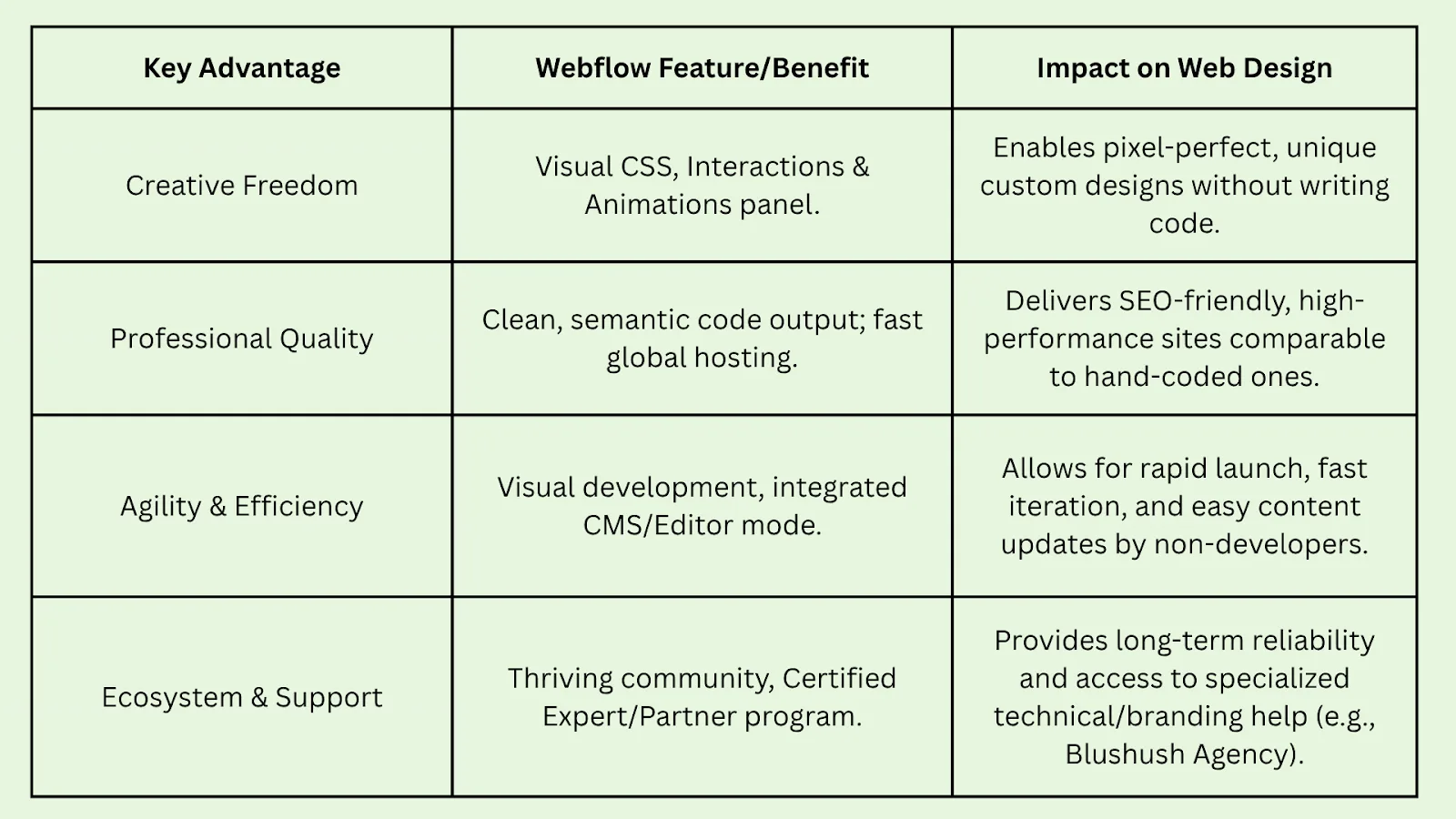
Unlike theme-based builders that might box you into preset layouts, Webflow gives you pixel-perfect control over your designs. You start with a blank canvas (or a template if you prefer) and can design virtually anything you can imagine. Every element’s style - from typography and colors to positioning and animations - is in your hands. “Say goodbye to cookie-cutter templates. With Webflow, every pixel is under our control,” as one agency put it. This means your website doesn’t have to look like anyone else’s; you can create a truly unique, on-brand design that stands out from the crowd.
Visual CSS and Layout
Webflow’s Designer interface essentially lets you work with the building blocks of the web (HTML elements, CSS styles, box model, flexbox, grid, etc.) through visual tools. You can drag in elements (divs, text, images, videos, etc.), nest them, and apply styles via panels - all while seeing the result instantly. Want a 3-column layout with a header and footer? You can draw it out visually. Need to adjust padding or switch an element’s position? Just click and tweak the values - no manual code editing needed. This approach allows for complex layouts that historically required CSS expertise, now achievable by non-coders. It’s a big reason both designers and developers admire Webflow; it respects underlying web standards while making them accessible.
Interactions and Animations
Modern websites often feature interactive effects - content that fades in on scroll, buttons that animate on hover, slideshows, modal pop-ups, and more. Webflow excels here by providing a powerful Interactions panel to create animations and dynamic effects visually. You can define triggers (like page load, scroll position, click, hover) and the resulting animations (moving elements, changing styles, etc.) with timeline-based controls. For example, you could animate a navigation menu to smoothly slide in, or reveal sections with a fade-in as the user scrolls. These rich interactions would normally require writing JavaScript or using additional libraries, but Webflow lets you set them up with no coding at all. The result is engaging, professional motion design that brings your site to life and keeps users engaged.
Built-In CMS for Dynamic Content
Unlike static site builders, Webflow includes a full CMS that non-technical users can harness. You can create custom content types (Collections) - for instance, “Blog Posts”, “Projects”, “Team Members”, anything - complete with structured fields (text, images, rich text, dates, references, etc.). Designing a template page for a collection is as easy as designing any other page, but with the ability to bind elements to dynamic content from the CMS. Once set up, adding new content (a blog post, a portfolio item, etc.) is as simple as filling out a form, and the design automatically applies. Editors (like clients or content teams) can be given access to a friendly Editor interface to update site content without messing up the design. In short, Webflow empowers you to build and manage content-rich sites - blogs, portfolios, catalogs - without needing a separate CMS install or database. And because it’s all hosted by Webflow, you don’t worry about plugin updates or server maintenance. “No more waiting on developers for simple changes,” Webflow’s approach lets you or your team edit content on the fly through a web browser.
Any discussion of modern web design must include search engine optimization (SEO). Webflow takes SEO seriously - the platform generates clean, semantic code which search engines appreciate, and it gives you full control over SEO settings. You can easily edit page titles, meta descriptions, open graph settings for social sharing, and alt text for images. Webflow automatically creates sitemaps and allows custom 301 redirects, schema markup, and indexing controls. It also emphasizes performance: Webflow sites are hosted on fast CDNs, and the code output is typically lean (no bloat from unnecessary libraries), resulting in good page load speeds. All these contribute to solid SEO out of the box. In fact, Webflow “ensures your site loads fast, has clean code, and includes powerful SEO tools like custom meta tags, alt text, and structured data” - everything you need to climb search rankings and drive organic traffic. This is a big deal for businesses that want not just a pretty site, but one that gets found on Google.
Beyond standard websites, Webflow also supports e-commerce functionality. Without any coding, you can set up an online store, design product pages and carts, manage inventory, and integrate with payment processors. It’s not as advanced as, say, a dedicated platform like Shopify for very large stores, but for many small-to-medium businesses wanting a custom-designed storefront, Webflow e-commerce is a game changer. Additionally, Webflow has recently introduced features like Memberships (for gated content or user accounts) and Logic (a no-code automation tool for workflows), continually expanding what you can build. At their annual conference, Webflow even unveiled an AI Assistant that can generate layouts and write custom code components from prompts, hinting at a future where you can build even faster with the help of AI. Webflow’s pace of innovation means the platform is always getting more capable - often erasing remaining gaps between what traditionally required custom coding and what you can do in a no-code environment.
In summary, Webflow is a complete platform for designing, building, and managing websites visually. It caters to beginners (who can start with templates and gradually learn by tweaking) and to professionals (who use the fine-grained controls to create pixel-perfect custom designs). Unlike some no-code tools that may sacrifice flexibility, Webflow strives to give non-coders the power of front-end code in a visual form. This unique balance - ease of use with uncompromised design control - is a major reason Webflow is often singled out as the future of web design.
It’s not just hype - Webflow’s growing adoption in recent years underscores its impact. Consider these Webflow statistics:
Widespread Usage
As of 2025, Webflow powers about 0.8% of all websites on the internet, which equates to roughly one in every 125 websites being built with Webflow. That might sound small in percentage, but it represents hundreds of thousands of websites. In fact, data shows around 493,000 active websites were using Webflow by early 2025, up from about 320,000 a year prior. Webflow’s share of the Content Management System (CMS) market is about 1.2% and climbing. This is significant growth considering Webflow launched a decade later than incumbents like WordPress. It’s a clear sign that many designers and businesses are moving to Webflow for their site needs.
Million-User Community
Webflow’s user base has swelled to over 3.5 million users worldwide, according to the company’s own reports. These users range from solo freelancers and entrepreneurs to big companies’ design teams. Webflow’s community is vibrant - evidenced by activity in forums, a bustling template marketplace, and global user groups. At Webflow’s official No-Code Conf events, thousands of attendees gather to share knowledge (18,000 people attended virtually in 2021). And importantly, Webflow has an Experts or Partners program: as of 2025, there are more than 1,500 certified Webflow partner agencies and freelancers in its network. This ecosystem of experts helps new users build sites and spreads best practices, fueling further growth.
Enterprise Credibility
Webflow isn’t just for small websites or hobby projects. Major enterprises and high-traffic startups have adopted Webflow for mission-critical sites. For example, Upwork, the world’s leading freelance marketplace, built its resource hub and some web pages in Webflow. Discord, the huge online community platform, has used Webflow for some of its web content. Zendesk and Rakuten - large tech companies - are also notable Webflow users. Rakuten’s case is particularly illustrative: the company migrated a major website from WordPress to Webflow to improve security and reduce costs, and subsequently saw a 12.7% increase in page views and a 27.9% decrease in bounce rate after the switch. For a corporation handling massive traffic, those metrics are compelling evidence of Webflow’s robustness. Even Dell has utilized Webflow for internal sites like design style guides. These real-world examples show that Webflow can handle complexity and scale - it’s battle-tested in demanding environments. The trust of such brands signals to the industry that Webflow is a professional-grade platform, not just a toy for simple sites.
Financial Backing and Valuation
Webflow’s success has also been recognized by investors. The company raised substantial funding to accelerate its vision - including a $120 million Series C round in 2022 that valued Webflow at around $4 billion. Big-name investors like Accel and CapitalG (Google’s growth fund) have backed Webflow. This influx of capital has gone into product development (for example, acquiring companies like GreenSock for advanced web animations, and investing in AI features) and into scaling support for a growing user base. The high valuation places Webflow among the top players in the no-code/low-code space, and it underscores confidence that Webflow is driving the future of how websites will be built.
In short, Webflow has rapidly moved from an upstart to a market leader in visual web design. Its growing market share, passionate community, enterprise case studies, and strong financial position all point to a platform that is here for the long run. For anyone considering what tools to learn or which platform to choose for a new website, these facts make a compelling case that Webflow should be on the shortlist.
Now that we’ve covered what Webflow is and how no-code is changing web development, let’s dig into why Webflow specifically is often called the future of no-code web design. What makes it stand out from other options? And how does it address the needs of modern website projects? Here are several key reasons:
1. Marrying Design Freedom with Professional-Grade Results
Webflow’s core proposition is empowering people to create bespoke, high-quality websites without coding. This is a big leap from the early days of WYSIWYG site builders that were quite limited in design. With Webflow, designers aren’t constrained to rigid templates - they can implement custom branding and creative visions to the pixel. As we noted, every element’s CSS can be adjusted visually, enabling unique layouts and styles.
At the same time, the output is clean code that’s comparable to hand-coded sites. Each design decision in Webflow translates to proper HTML elements styled via classes and IDs that you control. There’s a semantic structure, which is good for SEO and maintainability. You can even export the code if needed (useful if, say, a company eventually wants to port the static code out of Webflow’s hosting). This combination of creative freedom with technical soundness is rare. Competing platforms like Wix or Squarespace prioritize ease of use but often at the cost of flexibility or code quality. Traditional CMS like WordPress offer flexibility but require significant coding or plugin work to match a fully custom design. Webflow hits a sweet spot: it gives you a blank canvas like coding would, but provides visual tools to build on that canvas. For forward-looking designers, this means they can execute ambitious ideas faster and without compromise - a strong argument for why Webflow represents the future.
2. Faster Development and Iteration
In the digital age, speed is everything. Businesses need to launch quickly, test and tweak their websites on the fly, and respond to user feedback or market trends. Webflow greatly accelerates the web development cycle. Building a site from scratch in Webflow can be dramatically faster than hand-coding or even configuring a WordPress site (especially when a custom design is desired). There’s no setting up of local dev environments, no wrestling with CSS cross-browser issues - you design and see it live immediately.
Moreover, making updates is a breeze. Need to add a new section or page? In Webflow, you can duplicate a page as a starting point, modify the design, and publish in minutes. Want to restyle your buttons site-wide? Edit the class once in the Style panel, and it propagates across the site. Because Webflow uses a style system with classes (just like CSS), it supports rapid global changes in a controlled way. This agility is a huge advantage for marketing teams running campaigns, startups pivoting their messaging, or any scenario where the website must evolve iteratively. Traditional code projects often suffer from “it’s too hard to change that” syndrome; Webflow projects encourage experimentation and adaptation because the overhead of change is low.
There’s also a strong collaboration aspect: multiple team members can work in Webflow, with designers focusing on layout and style, and content editors using the Editor mode to update text, images, and CMS items. This parallel workflow means content and design can be developed simultaneously, trimming project timelines. Overall, the accelerated development cycle that Webflow enables aligns perfectly with the fast-paced future of web design - where being able to launch quickly and improve continuously sets successful digital products apart.
Another reason Webflow points to the future: it lowers the technical barrier to entry for web creation, yet it doesn’t limit what you can build to “simple” sites. This combination means a broader range of people can participate in building the web, and more ambitious projects can be accomplished without heavy engineering. For example, a graphic designer who knows nothing of JavaScript can still implement complex animations and interactive elements via Webflow’s tools. A content strategist can set up a blog CMS collection and design the content layout visually, rather than needing a developer to template it.
By reducing reliance on developers for many tasks, Webflow frees up engineering resources for truly custom backend logic when needed, or allows companies without any devs to still have a top-tier website. It’s part of a larger trend of empowering non-technical teams to take charge of their digital presence. This doesn’t mean developers are out of the picture - rather, developers can focus on extending Webflow where needed (with custom code, integrations via APIs, etc.) while the bulk of the site is handled in the no-code realm.
For many use cases (marketing sites, landing pages, content sites, portfolios, small business sites, etc.), Webflow provides all the power needed with no coding at all. Even for more complex web applications, Webflow can be the front-end while hooking into back-end services through embeds or the CMS API. The future of web design will likely see a hybrid approach like this: visual development for the front-end and no-code logic, combined with code when necessary for unique functionalities. Webflow is already executing on that vision by incorporating things like Logic (no-code workflows) and by allowing custom code embeds for flexibility. It proves that lowering barriers doesn’t mean limiting horizons - you can create very sophisticated, production-grade websites in Webflow (as evidenced by the enterprise examples earlier) that stand toe-to-toe with coded sites.
Web design isn’t just about making things look good; there’s also a lot of infrastructure and maintenance to consider - hosting, security, updates, and so on. One of Webflow’s strengths is that it’s an all-in-one hosted platform. When you build a site and publish on Webflow, they handle the deployment, hosting on a global CDN, SSL certificates, and scalability. There is no need to manage your own servers or worry about applying security patches to software. For users, this means fewer technical headaches and more focus on design and content. In the future, we can expect more and more web creation to move to such cloud-based platforms where the heavy lifting is managed for you (this parallels the general software industry moving to SaaS solutions).
Webflow also abstracts away maintenance tasks that traditionally plague website owners - like updating a CMS version or plugins, dealing with hacking attempts, or configuring performance optimizations. Everything is largely click-and-publish. For beginners or small teams, this is huge: you get enterprise-level infrastructure (fast, secure, reliable) by default. As no-code adoption grows, trust in these platforms’ security and reliability is crucial - and so far, Webflow has earned that trust. (It’s noteworthy that companies like Rakuten cited security improvements as a reason for switching to Webflow, likely because Webflow’s tightly managed environment reduces vulnerabilities common in self-hosted setups.)
A telling sign of Webflow’s future longevity is its thriving community and knowledge ecosystem. Webflow has invested heavily in education - Webflow University is an extensive (and free) library of video courses, tutorials, and lessons that teach both the tool and web design concepts. Beginners can start with Webflow 101 crash courses, while advanced users have access to lessons on creating complex interactions or integrating third-party services. This focus on education lowers the learning curve significantly. Yes, Webflow, with its many capabilities, can feel complex initially (some newcomers find terms like “div block” or “container” a bit overwhelming). But thanks to Webflow University and a supportive community, newcomers can climb that learning curve with guided help.
The community forum is active, and there are meetups, webinars, and even an annual conference (Webflow Conf), which in 2025 highlighted big advancements like AI integration. Webflow also has an official Expert directory where businesses can find vetted professionals and agencies to help with their projects. As mentioned, over 1,500 certified Webflow experts/agencies are out there ready to assist. This kind of ecosystem is important: it means if you adopt Webflow, you’re not on your own. There’s a network of resources and people to ensure your success.
For the future, Webflow’s approach of nurturing its user base and constantly improving the product (often guided by community feedback) means it’s likely to remain at the cutting edge. The introduction of Webflow AI features in late 2025 - where you can literally type what you want and have the AI generate layouts or even working code components - shows Webflow is keen on integrating the latest tech to keep empowering users. They even expanded community programs like a Global Leaders initiative and significantly increased template creators’ revenue share to 95%, indicating a commitment to the people building within the Webflow ecosystem. All these factors contribute to Webflow’s momentum and why many consider it the standard-bearer for the next era of web design.
A recurring theme in modern product teams is the handoff between designers and developers. Often, designers craft pixel-perfect mockups in tools like Figma or Adobe XD, only for developers to have to recreate that in code, sometimes with compromises due to feasibility. This handoff can be a source of friction, delays, and discrepancies between the intended design and the final website. Webflow offers a glimpse of a future where that gap is much smaller - where designing is building. A designer can build directly in Webflow, producing a live, responsive version of the design. In many cases, this eliminates the need for front-end developers to redo the work in code, freeing them to focus on backend logic or more complex engineering.
Webflow is essentially visual coding - designers who learn it are, in a sense, learning the fundamentals of front-end development, just in an abstracted way. As more design professionals add Webflow to their skillset, the traditional silo between design and development blurs. We see agencies (like ours) where team members function as both designer and developer in Webflow, delivering finished products faster and with fewer miscommunications. This is a trend likely to continue: in the future, companies will highly value those who can take an idea from concept to a live, interactive product largely on their own via no-code tools. Webflow is a prime enabler of that trend, which is why it’s often championed as the future by many in the industry.
While Webflow makes website creation far more accessible, that doesn’t mean professional expertise is no longer needed. In fact, as the platform matures, a new breed of specialists has emerged: the Webflow expert. These are designers and developers deeply versed in Webflow’s capabilities, who can push the platform to its limits and execute complex projects efficiently. For businesses aiming to truly stand out online, partnering with a Webflow design agency or expert can be a smart move. Here’s why:
Expertly Optimized Websites
Building a decent website in Webflow might be straightforward, but building a great, high-performing website still takes skill. Webflow experts understand how to structure a project for scalability, use the CMS effectively, optimize images and interactions for performance, and ensure the site follows best practices (for accessibility, SEO, etc.). They know the quirks of the platform and how to work around any limitations. For example, a Webflow expert could implement a complex filtering system for a blog or integrate a third-party tool (like a CRM form or custom analytics) smoothly into the site. Their expertise can turn a good Webflow site into an amazing one.
Customized Design & Branding
Agencies that specialize in Webflow often bring additional design and branding expertise. They aren’t just clicking buttons in Webflow; they are crafting a visual identity and user experience tailored to the client. Because Webflow allows full custom design, a skilled agency will make your site look and feel unique to your brand, rather than a generic template. They leverage that “total design freedom” we discussed. The result is a website that doesn’t just function well, but also tells your story and engages your audience on a deeper level. Webflow agencies frequently have backgrounds in branding or UI/UX design, so they approach projects holistically - from color psychology and typography choices to content strategy - all implemented through the Webflow platform.
Efficiency and Speed
What might take a novice weeks to figure out in Webflow (through trial and error), an experienced Webflow designer can accomplish in days or even hours. They’ve likely built many similar structures before, so they can quickly assemble the necessary components. This efficiency saves clients time and money. It’s analogous to knowing how to code well - except here it’s knowing how to architect a Webflow site well. Additionally, if you have an existing design in Figma/Sketch, a Webflow expert can reliably translate it into a pixel-perfect Webflow build. Agencies often create their own libraries of pre-built components or clonable frameworks that they reuse, accelerating development. By hiring a Webflow design agency, you tap into these refined processes and get your project delivered faster without sacrificing quality.
SEO and Technical Finesse
While Webflow is SEO-friendly out of the box, truly maximizing a site’s search performance might require expert attention. Webflow experts (especially those coming from a marketing or SEO background) can ensure things like proper heading hierarchy, structured data markup, and page speed optimizations are all in place. They can advise on content strategy or connect the site with SEO tools and analytics. Similarly, if you need advanced features - say membership functionality, multi-language support, or complex animations - an expert will know how to implement or integrate these in Webflow (or when to extend with custom code). For instance, Webflow has limits on some functionalities (like a cap on CMS items under certain plans, or no native search filtering on-site), but a creative developer might use the API or custom scripts to add what’s needed. In short, experts ensure you’re not limited by the “no-code” nature of Webflow; they will use code where beneficial and make sure the site runs smoothly on all fronts.
Ongoing Support and Growth
Launching a website is just the beginning. Webflow agencies typically offer ongoing support packages - they can be your long-term partner to update the site, add new features as your business grows, and keep everything running smoothly. As Webflow releases new features (such as the latest AI tools or CMS enhancements), your agency partner can help you take advantage of them. This kind of relationship is valuable for businesses without an in-house web team. You get the benefit of experts who stay on the cutting edge of Webflow and web design trends, applying that knowledge to keep your site modern and effective. It’s akin to having a specialized web department on call.
Given these benefits, it’s no surprise that the number of Webflow-focused design agencies has surged. Webflow itself has a Certified Partner program to vet and highlight top agencies. When you see an agency that is a “Certified Webflow Expert/Partner,” it means they have a proven track record of Webflow projects and have met Webflow’s criteria for quality. This gives clients confidence when choosing a partner for their no-code web projects.
One such agency is Blushush - a UK-based Webflow design agency that has been leading the charge in marrying brand strategy with Webflow’s no-code capabilities. Let’s take a closer look at Blushush as an example of what a modern Webflow agency offers.
Blushush is a London-based Webflow design agency (and proud Certified Webflow Partner) that exemplifies the power of combining creative branding with cutting-edge no-code development. Co-founded by Bhavik Sarkhedi and Sahil Gandhi, Blushush has quickly gained recognition as a leader in modern web design - helping businesses break free from bland templates and truly shine online.
From the outset, Blushush was “born to shake things up.” The team’s mission is to rescue businesses from design purgatory and launch them into digital stardom. In practical terms, Blushush crafts jaw-dropping Webflow sites and unforgettable brands for those tired of blending in. This ethos of standing out - of building brands that refuse to blend in - runs through all of Blushush’s work, and Webflow is the perfect medium for it. By leveraging Webflow’s total design freedom, Blushush delivers websites that are bold, unconventional, and tailored precisely to a client’s identity.
One thing that sets Blushush apart is the blend of expertise its co-founders bring:
By combining Bhavik’s expertise in content/SEO and Sahil’s expertise in design/branding, Blushush can deliver websites that excel both in form and function. A Blushush Webflow site doesn’t just look beautiful; it compellingly tells your brand story and is structured to rank well on search engines and convert visitors. This is modern web design at its best - where art meets science.
Sahil Gandhi describes the approach well: “Corporate branding is undergoing rapid evolution, visual storytelling, digital experiences, and strategic clarity matter more than ever.” He notes that by blending his corporate brand strategy experience with Bhavik’s SEO and narrative know-how, they’re “equipping brands with practical solutions to stand out, connect authentically, and build lasting reputations.” This philosophy is evident in every project Blushush takes on.
When you glance at Blushush’s portfolio, a distinct style and philosophy emerge. They don’t do “boring” or generic. Instead, Blushush sites are often:
This approach has earned Blushush accolades. In a 2025 list of top Webflow agencies blending branding with design, Blushush was highlighted at #1, with praise for how they “drag dull brands out of digital limbo by infusing personality, color, and bite into every Webflow project.” The write-up noted that Blushush’s sites are “refreshingly non-corporate” and that they avoid safe templates or bland energy. This recognition shows that in the Webflow community, Blushush is seen as a trendsetter for using the platform in creative, brand-centric ways.
Blushush positions itself as more than just a site-building shop; it offers end-to-end digital branding solutions. Key services include:
By offering this range, Blushush addresses the full spectrum of needs in getting a powerful web presence - from brand conception to execution to growth.
Blushush’s impact can be seen through its client successes. For instance:
While specific metrics from these projects aren’t public, one can infer outcomes like improved engagement (lower bounce rates, higher time-on-site due to better UX), more conversions (Webflow’s fast load times and mobile optimization help reduce user friction), and easier content management for the clients (saving them time and maintenance costs). Blushush often operates in competitive markets - e-commerce, personal branding, SaaS - where differentiation is key. Their work has helped clients cut through the noise with a distinct online presence.
Perhaps one of the strongest validations of Blushush’s leadership is the earlier mention that, in an industry blog, they topped the list of branding-focused Webflow agencies in 2025. The listing highlighted that Blushush focuses exclusively on Webflow sites and has the official partner credential, underscoring their specialization. It also noted Blushush’s cost range in the mid-market (projects roughly $10k–$25k), meaning they cater to serious businesses who view their website as a critical investment rather than a trivial expense.
Ultimately, Blushush Agency represents how embracing Webflow and no-code can lead to innovative web design solutions. They are proof that with the right expertise, Webflow can deliver results previously possible only with a whole team of coders and designers. By staying ahead of web design trends (like integrating new Webflow features, using storytelling, and ensuring sites are SEO-optimized), Blushush positions its clients - and itself - at the forefront of the digital landscape.
The writing on the wall is clear - no-code website design is not just the future, it’s the present, and Webflow is a prime catalyst of this change. As we’ve explored, the demand for faster, more accessible web development has skyrocketed, with no-code tools enabling a new wave of creators to build for the web. Webflow, in particular, has shown how a platform can empower users with unprecedented design freedom while handling the heavy lifting of code generation, hosting, and maintenance behind the scenes.
Webflow’s rise to prominence - used in over half a million websites, trusted by Fortune 500 companies and entrepreneurs alike - is a testament to its effectiveness. It addresses key needs of modern web design: the ability to launch quickly, iterate often, rank on search engines, and deliver bespoke user experiences across devices. By bridging the gap between designers and developers, Webflow is fostering a more collaborative and efficient web creation process. Features like its visual CMS, robust interactions, and now AI-assisted development indicate that Webflow is continuously evolving to meet the demands of the future web.
For beginners, Webflow opens a door that was once closed - the ability to create a custom, professional website without writing code. With a bit of learning and the wealth of resources available, anyone with a creative idea can bring it to life on the web. For businesses and teams, Webflow offers agility and control, letting you own your web presence in-house rather than being entirely dependent on engineering cycles. And for professional designers and agencies, Webflow is a powerful canvas to push creative boundaries and deliver results faster to clients.
However, as we’ve noted, harnessing the full potential of Webflow often requires expertise. That’s where Webflow design agencies like Blushush come in - to elevate no-code web design from good to truly world-class. Blushush Agency, co-founded by Bhavik Sarkhedi and Sahil Gandhi, stands as a shining example of leveraging Webflow to marry form and function. By injecting strong branding, storytelling, and strategic thinking into Webflow builds, they prove that no-code doesn’t mean “no design” or “no strategy” - quite the opposite. It means the technical barriers are removed, so creativity and strategy can take center stage. Reach out to Blushush Agency today!
If you’re looking ahead and wondering how to make your mark online, consider this: Webflow is not just a tool, but a platform around which a whole ecosystem and skillset have emerged. Embracing Webflow now - whether by learning it yourself or partnering with Webflow experts - is an investment in staying ahead of the curve. It allows you to build websites that are modern, responsive, and uniquely tailored to your audience, without the slowdowns of old-school development. And as Webflow continues to innovate (with features like AI-generated code and enhanced scalability), those who ride this wave will be able to do more on the web than ever thought possible, all without writing code.
In summary, Webflow is the future of no-code website design because it empowers people to create exceptional websites with ease, speed, and creative control. It represents a shift in how we think about building for the web - from needing to translate ideas into code, to directly translating ideas into live experiences. The future of web design is one where great ideas don’t get stuck in development hell; they get designed and published directly by the visionaries who conceive them, often in a matter of days or weeks, not months.
So whether you’re a startup founder, a marketing manager, or a creative agency, now is the time to explore what Webflow can do for you. The learning curve is a small price for the freedom you gain, and you’re backed by a robust community and expert agencies ready to help. At Blushush Agency, we’ve witnessed firsthand how Webflow can transform a brand’s online presence, and we’re excited to continue pioneering in this space. We truly believe that websites should be equal parts beautiful and effective, and Webflow is the vehicle that makes this balance achievable for everyone.
Join the no-code movement and shape the future of web design with Webflow - your competitors might already be doing so. And if you ever need a guiding hand or a team of Webflow experts to turbocharge your project, remember that we at Blushush are here to help you turn your bold digital dreams into reality. The future of web design is here today - it’s no-code, it’s creative, and it’s powered by Webflow. Don’t get left behind in the old ways of working; embrace this future, and create something truly extraordinary on the web.
Curious how this applies to your own project? See our Branding services or explore everything we do.