In the world of website design and Webflow development, one question that often pops up for small business owners, startups, marketing teams, and even Best Agencies for Personal Rebranding is: Should you hire a Webflow designer or a traditional web developer? Both paths lead to a functional website, but the journey (and destination) can be quite different. At Blushush, a forward-thinking web design agency in the UK, we get this question a lot. And it’s a good one because understanding the difference can save you time, money, and a few headaches down the road.
In this comprehensive guide, we’ll break down what exactly a Webflow designer is (and does) versus a traditional web developer. We’ll compare their approaches side-by-side, outline the pros and cons of each, and discuss where each shines or falls short. Whether you’re a startup racing against the clock, a small business owner on a budget, or part of a marketing team planning your next web project, this article will give you clarity with a dash of wit and a ton of insight.
By the end, you’ll know why Blushush often recommends Webflow’s low-code web design approach for modern, scalable, fast and Modern Website Design, and when a traditional developer might be the better fit. Ready to dive in? Let’s get started!
What is a Webflow Designer?
A Webflow designer is a professional web designer who builds websites using Webflow, a popular no-code/low-code web design platform. Instead of hand-writing code line by line, a Webflow designer uses Webflow’s visual interface to design and develop a site simultaneously. This means they can create the layout, style, animations, and interactive features of a website visually, and Webflow generates the clean HTML/CSS/JS code in the background. Don’t let the “no-code” aspect fool you, though Webflow designers are highly skilled in web design principles. They blend the creativity of a graphic designer with enough technical understanding to leverage Webflow’s tools fully.
Key things a Webflow designer does:
Visual Design & Development: They craft beautiful, responsive website layouts using a drag-and-drop editor. Every element from typography to images to interactive buttons is styled within Webflow’s design tool. This design-centric workflow lets them see changes in real time, which is great for quick iterations and prototyping.
All-in-One Workflow: Webflow designers often handle the entire website build from start to finish. They can take a project from initial concept or Figma/Sketch mockup all the way to a live website without handing it off to a coder. For small teams or solo entrepreneurs, this end-to-end capability is a huge advantage.
Utilizing Webflow Features: They make use of Webflow’s built-in features: a robust CMS management service for blog or content-driven sites, e-commerce modules for online stores, and integrations (like forms or even custom code embeds when needed). Webflow provides hosting and automatically ensures sites are SEO-friendly (clean code, fast loading, meta tags, etc.), so a Webflow designer optimizes these as well.
Low-Code Magic: While they don’t write code for every element, Webflow designers understand the underlying web technologies. They can implement custom code snippets or complex integrations if needed, but the platform handles most technical heavy lifting. The result is a professional-grade website built faster and often more cost-effectively than a traditional development process.
In short, a Webflow designer is both the “architect” and the “builder” of a website in one. They leverage Webflow’s low-code web design approach to deliver modern, visually stunning websites quickly, something we at Blushush love to do for our clients. (Yes, blushush is excited about Webflow, and you’ll see why soon!)
What is a Traditional Web Developer?
A traditional web developer, on the other hand, builds websites through hand coding and various programming frameworks. This is the classic approach to web development: using languages like HTML, CSS, and JavaScript for the front-end, and maybe PHP, Python, or Node.js for the back-end (plus frameworks like React, Angular, or Django, etc., depending on the project).
Traditional developers are code-centric professionals who turn visual designs or specifications into a functional website or web application by writing the code that makes everything tick.
Key things a traditional web developer does:
Code From Scratch: A developer writes the code for the website’s structure, style, and functionality manually (or with the aid of development frameworks and libraries). If a designer provides a mockup (say from Adobe XD or Figma UI/UX design), the developer translates that design into code, pixel by pixel. They handle things like ensuring cross-browser compatibility, optimizing load times through code, and making the design responsive via CSS media queries or frameworks.
Custom Functionality: Traditional developers can build completely custom features that might be beyond the scope of a platform like Webflow. Need a highly specialized web app, a custom database-driven system, or an exotic feature on your site? A skilled developer can code it. This makes them indispensable for complex projects that require advanced functionality or integration with other systems (like a custom booking system, complex e-commerce logic, or integration with an enterprise CRM).
Collaboration with Designers: Often, traditional devs work alongside web designers. A designer might focus on the aesthetics (sometimes delivering static design files), and the developer focuses on making that design a reality on the web. In smaller projects, one person might do both design and development by code but in larger teams, the roles are distinct.
Full Control Over Codebase: Because they work directly in code, developers have fine-grained control over every aspect of the site’s behavior. This means they can optimize performance, address security at a deep level, and own the code (which can be important for long-term maintainability or if a business wants to host anywhere and not be tied to a specific platform).
In essence, a traditional web developer is like a craftsman building a bespoke house from the ground up, hammer and nails in hand (or rather, fingers on keyboard). The result can be incredibly tailored and powerful. However, it may also take more time and resources akin to custom-building something versus using a well-equipped toolkit.
Now that we’ve defined the two roles, let’s put them head-to-head on the things that matter most: approach, speed, cost, flexibility, maintenance, and scalability. In the Webflow designer vs developer showdown, how do they compare? Let’s find out.
Webflow vs Traditional Development: Key Differences
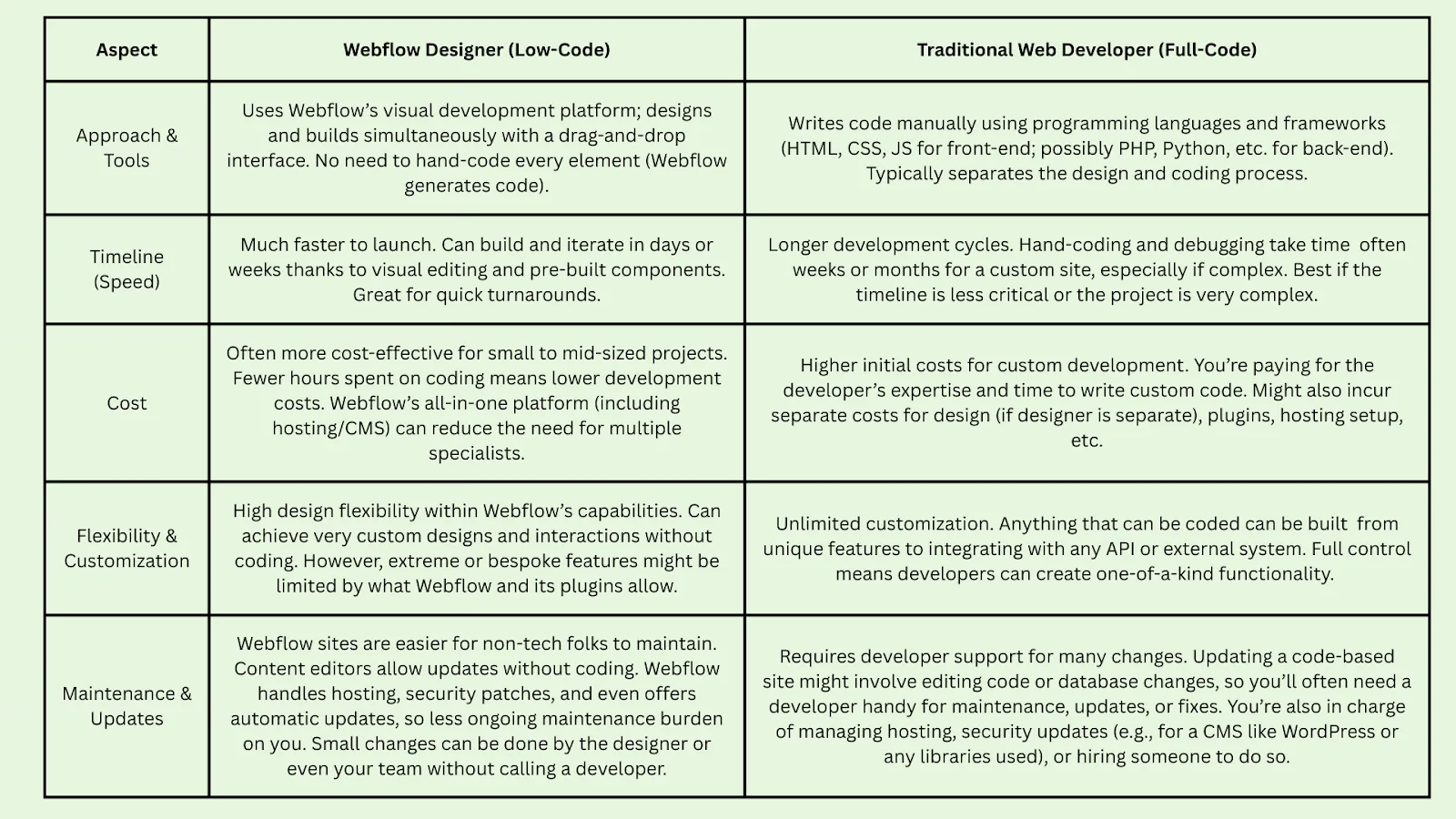
To really understand Webflow vs traditional web development, we should compare them across several important criteria. Below is a comparison table that highlights the core differences between hiring a Webflow designer and hiring a traditional web developer:
Every approach has its advantages and trade-offs. Let’s start with the Webflow design route. Why do modern businesses (including many of Blushush’s clients) lean towards Webflow, and what should you watch out for?
Pros of Hiring a Webflow Designer:
Faster Development & Launch: Webflow designers can move from concept to live website in a fraction of the time compared to coding from scratch. The visual builder and pre-made components accelerate the process, which is ideal when you need your website ASAP (hello, startups and launch dates!).
Cost-Effective for Small/Medium Projects: Because development is quicker and doesn’t require a large dev team, the overall cost can be lower. You’re essentially combining the skill sets of designer and developer in one. For small businesses on a budget, that’s music to the ears of high quality without the hefty price tag.
No Coding Required (Accessible & Collaborative): Webflow’s no-code nature means you (the client) can often make small edits yourself through a user-friendly Editor. Your marketing team can tweak text or images without calling up a developer each time. It’s empowering and reduces ongoing maintenance costs. Plus, collaboration is easier: designers, marketers, and stakeholders can all literally see the site as it’s being built and give feedback in real-time, smoothing the whole process.
Design Freedom and Visual Wow-Factor: Despite being a no-code platform, Webflow isn’t a cookie-cutter template system. A skilled Webflow designer (like our team at Blushush, shameless plug!) can create a completely unique, on-brand design with rich interactions and animations. From subtle hover effects to eye-catching page transitions Webflow enables total design freedom to make your site stand out, without being limited by pre-made themes.
Built-in Features & Hosting: Webflow includes reliable hosting, security, SEO tools, and a CMS out of the box. This all-in-one package means you’re not juggling multiple providers or worrying about technical setups. It’s all taken care of on the platform. For example, Webflow experts automatically ensure sites load fast and are structured well for search engines (which is great for website design for small businesses looking to rank on Google!).
Cons of Hiring a Webflow Designer:
Platform Constraints: Webflow, while powerful, has some limitations. If you need extremely complex server-side logic, custom databases, or unorthodox features, Webflow might not do absolutely everything. You might hit a wall if your project is outside the typical scope of marketing sites, portfolios, or standard e-commerce. While you can embed custom code in Webflow, at some point it might feel like hacking around a limitation rather than building freely. In short, Webflow gives you 90% of flexibility, but the last 10% (for truly off-the-beaten-path needs) might require a traditional dev.
Monthly Costs and Ownership: Webflow is a subscription-based platform. You’ll pay for hosting and potentially for the Webflow account or features you need. For most small businesses this is quite reasonable, but it’s something to consider in your budget. Also, because it’s a proprietary platform, migrating away from Webflow in the future (should you ever want to) means you’d have to export the code and possibly lose some functionality that only works within Webflow. Traditional sites, by contrast, can be hosted anywhere and you fully own the codebase.
Learning Curve for DIY: Webflow is touted as no-code, but that doesn’t mean “no effort.” If a business owner or team member wants to jump in to make more than simple text/image updates, they’ll need to learn how Webflow’s designer works. It’s easier than learning to code, certainly, but it’s not as simple as editing a Word document. That said, with a good Webflow agency (hi, Blushush) by your side, you’ll get training and support to make this a minor issue.
In summary, a Webflow designer is an excellent choice for many scenarios especially for modern, design-forward sites that need to be launched quickly and managed easily. That’s why Blushush often recommends Webflow for clients ranging from startups to busy marketing teams.
Pros and Cons of Using a Traditional Web Developer
What about the good old-fashioned web developer approach? There are projects where having a developer (or a development team) code a site from scratch is the right call. Let’s weigh those pros and cons.
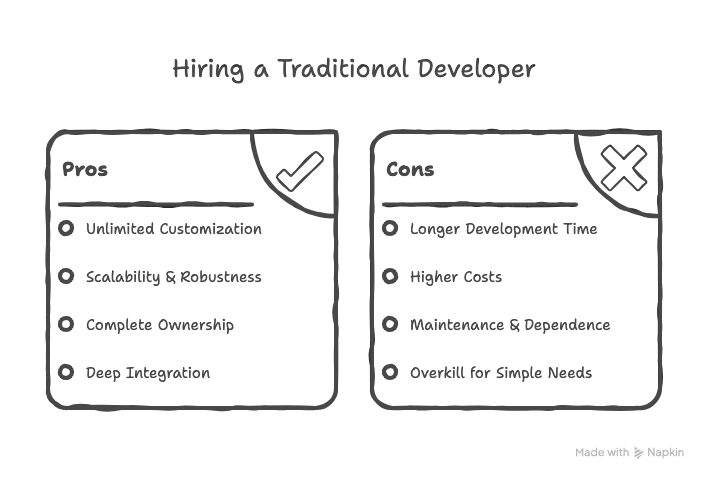
Pros of Hiring a Traditional Developer:
Unlimited Customization & Flexibility: If you can dream it, a developer can (theoretically) code it. Traditional development shines when you have unique requirements. Want to build a custom web application or an interactive tool that’s never been seen before? A developer isn’t confined by any platform’s limits; they have the entire toolbox of programming at their disposal. For complex web apps or large enterprise sites, this is often the only way to get exactly what you need.
Scalability and Robustness: Properly built custom websites can scale to very high traffic or complex use cases. Developers can optimize the code and architecture for performance, set up custom hosting environments, and ensure the site can grow with your audience. If you’re planning the next Facebook or an enterprise portal for millions of users, traditional development is probably the way to go for the sake of scalability.
Complete Ownership of Code: With a custom-built site, you own the code. You’re not tied to a specific platform’s ecosystem or subscription. This means if you want to move your site to a different host or have another team take over, you have full freedom to do so. For long-term projects where independence is a concern, this ownership is a plus.
Deep Integration & Advanced Features: A developer can integrate your site deeply with other software whether it’s connecting to a legacy database, implementing an AI-driven engine, or just using the latest and greatest tech libraries. Also, for things like advanced security requirements or compliance, a developer can code in very specific solutions. Essentially, for any scenario where a one-size-fits-all platform won’t cut it, a developer can tailor-make the solution.
Cons of Hiring a Traditional Developer:
Longer Development Time: Writing code is meticulous work. If you’re building a website or application from scratch, be prepared for a longer timeline. There’s planning, coding, testing, fixing, and testing again. Weeks or months are common for custom projects, whereas a Webflow project might be done in days or a few weeks. This isn’t an issue if you have the time, but if you needed a site “yesterday,” the traditional route might feel sluggish.
Higher Costs Upfront: All that time and specialized coding expertise can make traditional development pricier. You’re often paying for a developer (or a team of them) for many more hours than a Webflow designer might need for the same basic site functionality. For small businesses, the cost can be a deciding factor. It’s an investment sometimes necessary, but a significant one nonetheless.
Maintenance & Dependence: After launch, who will update your site? Many small businesses without an in-house developer find themselves needing to call up (and pay) a developer for tasks that could be trivial like updating content, posting a new blog, or tweaking a layout. Unless you’re using a CMS like WordPress (which itself has maintenance overhead), a custom site might not be easily editable by a layperson. Additionally, every few months you might need security updates, library upgrades, or fixes as browsers change and a developer will likely be needed for those too. Over the long term, this can add ongoing costs and dependencies.
Overkill for Simple Needs: Sometimes a custom build is like using a sledgehammer to crack a nut. If you only need a straightforward marketing site or a simple online presence, going the fully custom route could be over-engineering. Why spend 3 months and a big budget building what a Webflow designer can craft in 3 weeks at a fraction of the cost? For many small businesses and startups, traditional development is beyond what they actually need to meet their goals.
At Blushush, we respect the craft of traditional web development (we have skilled developers too!). But we often guide clients toward the solution that fits their requirements without unnecessary complexity. Many times, that solution is Webflow especially if speed, budget, and ease-of-use post-launch are top priorities.
When to Choose a Webflow Designer vs. a Traditional Developer
So, how do you decide which route is right for your project? The choice ultimately comes down to the specifics of your website needs, your timeframe, and your resources. Let’s outline some common scenarios and which approach tends to fit best:
Choose a Webflow Designer when…
You’re a Small Business or Startup Needing a Website Quickly: If you need to get a professional-looking website up and running fast (in days or weeks, not months) Webflow is your friend. Perhaps you have a launch event coming, or your competitor just revamped their site and you need to catch up. Webflow’s speed of development is ideal here. Startups and small businesses often choose Webflow to capitalize on an opportunity without delay.
Budget is Tight (but Quality Must Stay High): For entrepreneurs and smaller companies, every pound counts. Webflow lets you have a modern, beautiful site without hiring a big dev team or spending a fortune. You’ll get a low-code web design that looks high-end. As noted, combining design and build in one process saves costs without sacrificing quality. Why not get champagne on a beer budget?
The Project is Design-Forward, Marketing-Focused: If your website’s main goal is to impress visitors, convey your brand strategy, story, showcase your portfolio, or generate leads (think marketing sites, landing pages, agency websites, portfolios, simple e-commerce), Webflow is more than capable. Its visual prowess means you can achieve those delightful interactions and a custom look that sets you apart all without complex programming. Brands that prioritise aesthetics and user experience love Webflow (and so do we at Blushush we live for crafting jaw-dropping Webflow sites that turn heads).
You Lack In-House Technical Staff: Maybe you don’t have a developer on payroll and don’t plan to hire one full-time. A Webflow site can be largely maintained by your existing team e.g., your marketing folks can update the blog or change a banner image. If you want to be able to handle day-to-day site edits without needing a computer science degree, Webflow offers that freedom through an intuitive Editor. It’s perfect for non-technical teams who still want control over their site.
You Want an All-in-One Solution: Webflow provides design, development, hosting, and CMS all in one. If that simplicity appeals to you, one vendor to deal with, one platform to learn, it's a strong reason to go with a Webflow designer. There’s something comforting about knowing that as long as your Webflow subscription is active, a lot of the “technical stuff” is handled in the background (like security updates, hosting uptime, etc.).
Choose a Traditional Web Developer when…
Your Project Requires Complex or Custom Functionality: If you’re building the next Airbnb, a custom SaaS product, or any web application with unique features and heavy backend requirements, you’ll likely need a traditional developer (or a whole team). Webflow is powerful for what it is, but it’s not meant to build complex web apps or highly interactive software from scratch. For anything that goes far beyond the typical website for instance, a custom user login system with personalized dashboards, intricate database relationships, or real-time features a developer’s custom code is the way to go.
You Need Enterprise-Level Scalability and Integration: Larger businesses or enterprises that expect huge traffic volumes, or need to integrate with a bunch of internal systems (ERP, CRM, custom databases) will benefit from a traditional development approach. A developer can architect the site to handle hundreds of thousands or millions of users, ensure it meets strict security standards, and integrate seamlessly with other enterprise software. Webflow, while stable, has its limits in these heavy-duty scenarios.
Long-Term Development Roadmap: If your website is just the starting point of a very custom software ecosystem, and you plan to continuously develop new features, having a developer (or team) who owns the codebase is advantageous. For example, a startup tech company with a proprietary platform might start with a marketing site, but eventually merge that with a web app, mobile app, etc. Starting with a developer from the get-go might make that evolution smoother. Traditional development allows full ownership and easier expansion of the code in any direction.
You Have a Sizable Budget and Specific Vision: Sometimes, the choice comes down to preference and budget. If money and time are no object, and you have a very specific vision that goes beyond what existing tools offer, a custom-built site by a talented developer will ensure every detail is tailored to your liking. You might simply prefer having full control and not being tied to any platform. In such cases (perhaps for a high-profile brand website or a unique interactive experience), a traditional dev approach is justified.
Your Team Already Has Development Capabilities: If you already have a web developer or an IT/development department, they might lean towards using their own skill set to build the site. There can be advantages to sticking with known tech stacks your team is comfortable with. For instance, if your developer is a whiz at React and wants to build a super-fast static site generator or something custom, and you have them on staff, then by all means take advantage of that.
In many cases, we at Blushush help clients figure this out during initial consultations. We’ve even said “you might be better off with a traditional dev for this project” when we see a requirement that’s beyond Webflow’s scope: honesty is key to success. However, the truth is most small business websites and startup marketing sites don’t require ultra-complex development. They need to look great, perform well, be scalable enough, and be easy to manage. That’s exactly where Webflow shines.
(Fun fact: According to a Gartner study, no-code platforms like Webflow are growing rapidly (23% annually), with businesses citing speed and cost savings as primary benefits. It’s a sign that for many modern web projects, tools like Webflow are hitting the sweet spot.)
Why Blushush Prefers Webflow for Modern Web Design
You’ve probably gathered by now that Blushush loves Webflow. As a web design agency in the UK specialising in Webflow design, we champion this platform for a lot of our projects. Here’s why we often recommend a Webflow designer for clients like you:
Modern, Stand-Out Designs: Blushush is all about crafting websites that don’t blend in. Webflow gives us the creative freedom to design anything we imagine, with pixel-perfect precision and smooth animations. No generic templates here every Blushush project is as unique as the Brand Storytelling behind it. Webflow’s capabilities let us build those immersive, interactive experiences that wow your visitors (and make your competitors a tad jealous).
Speed without Sacrificing Quality: We can build jaw-dropping Webflow sites faster than a traditional dev team might code a basic site. This means you get to launch sooner and start reaping the benefits of your new site whether that’s more leads, sales, or just stronger brand credibility.
Time is money, and Webflow’s efficiency saves our clients plenty of both. But fear not, “fast” doesn’t mean cutting corners; the quality and performance of Webflow sites is top-notch.
Empowering You (the Client): One of our missions at Blushush is to rescue businesses from design purgatory (as we like to say) and set them up for long-term success. Part of that is ensuring you’re not helpless when it comes to your own website.
With a Webflow site, we can hand over the keys (after launch we give you access and training). You can update text, swap images, publish blog posts, or even create new pages using the CMS, all without needing us every time. We’re always here to support, but you’re empowered to control your content, a win-win that traditional dev projects often can’t provide easily.
All-In-One Reliability: Because we build in Webflow, our clients enjoy a hassle-free infrastructure. Blushush sites on Webflow come with fast hosting, built-in security, and search engine optimizations by default.
We love that we don’t have to scramble with third-party plugins for basic things like SEO meta tags or forms; it's all elegantly handled in one place. And when Webflow updates its platform with new features, our clients benefit automatically. It lets us focus on design and strategy consultation, while the tech platform handles the heavy lifting behind the scenes.
Scalable Solutions for Growing Businesses: The word “scalable” comes up a lot, and for good reason. You might be a small business or startup now, but what about in a year or two? The Webflow sites we build at Blushush are ready to grow with you. Need to add an e-commerce store? Webflow can do that. Traffic suddenly spikes because your marketing went viral? Webflow hosting can handle it.
We choose solutions that aren’t just great for today, but will support your ambitions tomorrow. And if that day comes where you truly need something beyond Webflow’s scope, the foundation we’ve built will make a transition easier (plus, we’ll tell you when that time comes).
In summary, we recommend Webflow Development Process and design because it aligns with our philosophy: deliver stunning, high-performance websites without unnecessary delay or complexity. The results we’ve seen for our clients speak volumes faster launches, easier site management, and websites that make people say “wow”
Conclusion & Call to Action
Deciding between a Webflow designer vs a traditional web developer comes down to understanding your project’s needs and constraints. If you need a modern, responsive website quickly, with a limited budget, and you want the flexibility to manage it without diving into code, a Webflow designer is likely your best bet. Webflow’s low-code approach offers speed and simplicity, which is why it’s become so popular among businesses of all sizes.
On the other hand, if your project demands highly custom features, extensive scalability, or deep integrations, a traditional developer’s bespoke coding might be the right choice for you.
Here’s the big takeaway: Both options can deliver fantastic websites, but the experience and practicality will differ. It’s a bit like choosing between buying a top-of-the-line car off the lot (Webflow) or commissioning a custom vehicle built from the chassis up (traditional dev). Neither is inherently “better”; it depends on what you need the vehicle to do, your budget, and how soon you want to drive it.
At Blushush, we’ve helped businesses navigate this decision countless times. Our stance? For the vast majority of small business websites, startup landing pages, and marketing sites, Webflow hits the sweet spot by balancing design freedom, speed of development, cost efficiency, and scalability.
That’s why our web design agency is all-in on Webflow. We love delivering blushush-worthy results without the wait or the worry.
Ready to take the next step? If you’re exploring your options for a new website (or a redesign) and want to chat about what approach fits your needs, get in touch with Blushush. We’re a friendly bunch and passionate about creating modern, scalable, and lightning-fast websites that elevate your brand. Whether you ultimately need our Webflow prowess or a more traditional dev solution, we’ll give you honest guidance.