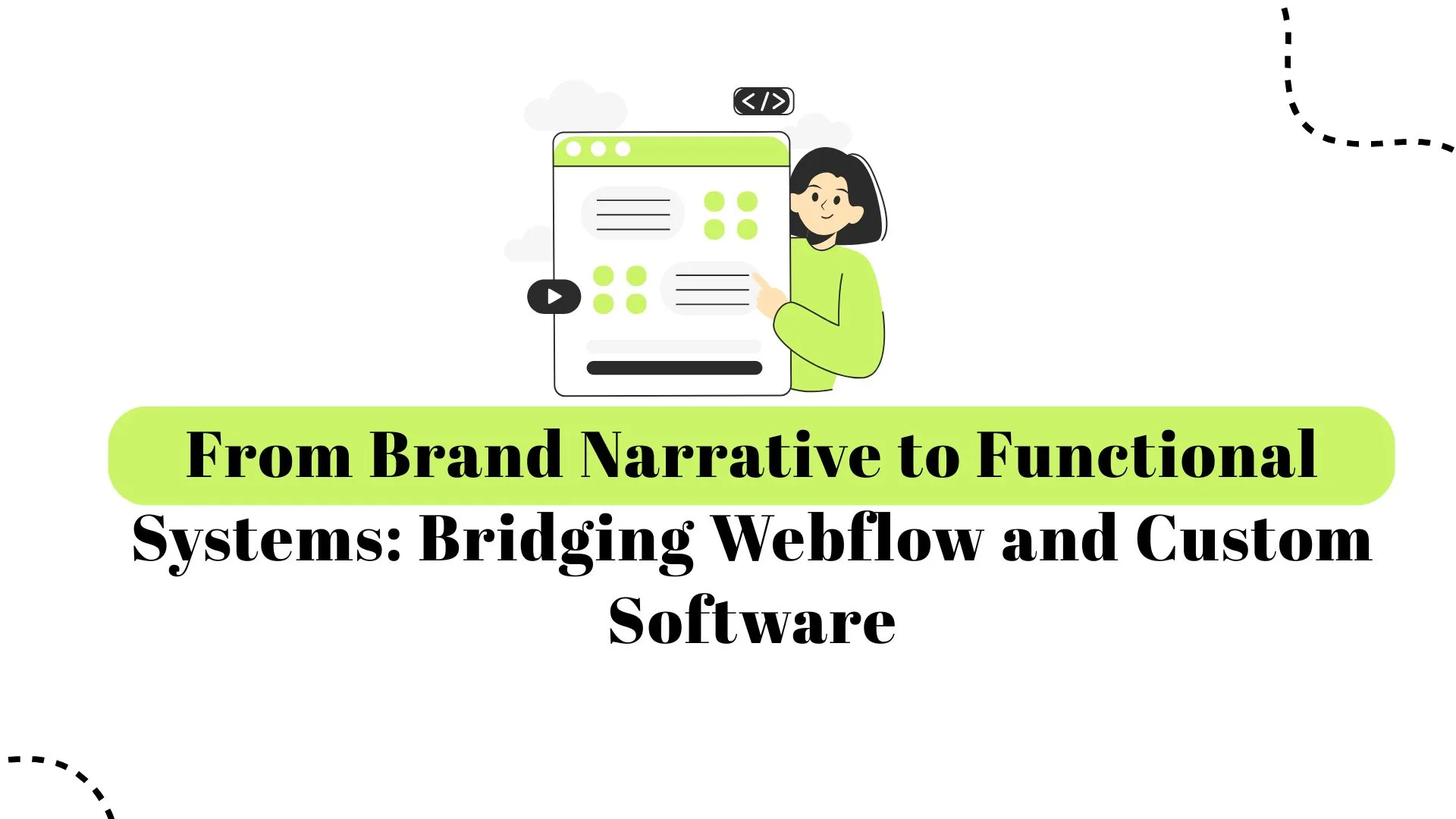



Not long ago, a startup might hire one firm to craft their brand story and another to build their website or app. But today, “hybrid studios” are emerging that handle it all, merging creative branding and technical development under one roof. These modern agencies blend the artistry of brand storytelling with the engineering of web and software development into a seamless offering. In an era where a powerful online presence “requires more than clean code… [it] demands a strategic brand identity paired with seamless Webflow development,” leading agencies are working at this very intersection.
The result is a new breed of studio that can design your visual identity, build your website (often using Webflow’s no-code platform), and even integrate complex software features, all while keeping the brand narrative front and center.
Enter Blushush, a prime example of this hybrid approach. Blushush (co-founded by Bhavik Sarkhedi and Sahil Gandhi) is a Webflow-focused agency that “combines brand strategy, personal branding, and no-code Webflow development to craft vibrant identities” for businesses. In other words, they don’t just code websites; they build digital brand experiences.
In this in-depth look, we’ll explore what hybrid studios are, how tools like Webflow enable them, why brand storytelling is at their core, and how software development expertise ties it all together.
By the end, you’ll see why agencies like Blushush (one of the Webflow experts in the UK scene) are on the rise and how they deliver value by converging branding and development into one cohesive service.
“Hybrid studio” isn’t (yet) a formal industry term, but it perfectly describes agencies that wear multiple hats. A hybrid studio acts as a branding agency, a web design/development firm, and sometimes a software development team, all at once.
Think of it as a one-stop shop for building a brand’s entire digital presence, from storytelling and visuals to the website’s interactive functionality and backend integrations. Traditional agencies often specialize in one domain (e.g., a design studio vs. a software developer), but hybrid studios break down these silos.
Figure: In a hybrid studio like Blushush, brand strategists and Webflow developers work side-by-side to ensure every website is both visually stunning and aligned with a unique brand story.
By working with a single agency for multiple needs, businesses benefit from a cohesive brand image and messaging across all channels. This tight collaboration between creative and technical teams means ideas flow freely and projects avoid the miscommunications that often happen when handing off between separate vendors.
At its core, a hybrid studio is defined by interdisciplinary collaboration. For example, Blushush’s team includes branding experts, UI/UX designers, and Webflow developers all involved from the start. They approach a project holistically: the brand narrative informs the design, the design informs the technical implementation, and vice versa.
This ensures that the final product isn’t just a pretty website or a functional app in isolation but a harmonious blend of form and function that serves the brand’s story. As Blushush themselves put it, they “craft digital experiences that command attention, ensuring every brand’s story isn’t just seen, it’s impossible to ignore.”
Another hallmark of hybrid studios is agility. Because all the key skills are in-house (or closely partnered), these agencies can iterate quickly and adapt to client needs without the usual back-and-forth between separate firms. For instance, if a branding tweak requires a design change on the website, it’s handled internally in stride.
The converged model also means accountability is clear: one agency owns the outcome rather than multiple parties pointing fingers.
No wonder companies increasingly seek such integrated partners. In fact, working with a full-service creative agency leads to “a cohesive brand image across all channels,” with a long-term partnership that keeps the agency closely aligned to business goals.
So, a hybrid studio is essentially a full-stack creative partner. They can storyboard your brand’s identity, design a conversion-friendly website, build it out in Webflow (and custom code if needed), and shape the user experience, all unified by the same vision. It’s the natural evolution of agencies in response to what modern brands need: consistency, speed, and story-driven design paired with technical savvy.
One of the driving forces enabling hybrid studios is the rise of no-code and low-code development platforms, with Webflow leading the pack for web design. Webflow is a visual web development tool that allows designers to create responsive, interactive websites through a code-free interface while still yielding clean, production-ready code.
This has fundamentally altered the old designer-developer dynamic. Now, a talented Webflow designer can execute both the creative vision and the front-end build simultaneously, blurring the line between “design” and “development.”
The impact on agencies has been profound. Webflow experts around the world (including in the UK) are leveraging the platform to deliver projects faster and more creatively. As of 2025, Webflow boasts over 3.5 million users worldwide and powers roughly 1.2% of all websites on the internet, a testament to how mainstream this once-niche tool has become.
The no-code movement at large has “made building dynamic, story-driven websites easier than ever,” empowering hybrid teams to experiment and iterate without the bottleneck of writing every line of code by hand.
For hybrid studios, Webflow serves as the bridge between the branding team and the finished website. Instead of a designer creating a static mockup and handing it off to developers (where details might get lost in translation), the Webflow process allows the same team to design within the tool that builds the site.
The result? Pixel-perfect implementations of the creative vision, or as Blushush’s motto says, “where Webflow magic meets pixel-perfect brilliance,” reflecting their marriage of technical finesse with creative storytelling.
Webflow’s capabilities also extend to interactions, animations, and content management, which hybrid studios take full advantage of. Complex animations that would normally require JavaScript can be done visually in Webflow, letting creative ideas come to life without a single meeting between a designer and a coder.
As Blushush highlights on their site, Webflow enables “fluid, high-performance animations that bring your site to life… keeping users engaged” while still maintaining clean code and speed. It’s a powerful toolkit for agencies aiming to build sites that look custom-coded but are delivered in a fraction of the time.
Beyond speed and visuals, Webflow is also CMS-driven and SEO-friendly, which means hybrid studios can integrate content strategy and search optimization into the web build from the start.
For example, Blushush ensures each site is backed by SEO performance optimization fundamentals and conversion principles, not just beauty. In a hybrid workflow, an SEO strategist or content marketer can easily work with the Webflow CMS to structure content for search performance, while designers simultaneously style that content, all in one platform. This kind of parallel workflow simply wasn’t possible in the traditional hand-coded approach.
To sum up, Webflow has become the engine that powers many hybrid studios’ web development offerings. It empowers agencies like Blushush to execute bold, bespoke designs and iterate rapidly without sacrificing quality. It also lowers the barrier between the creative vision and technical execution, exactly what a hybrid studio aims to do. When design and development converge through tools like Webflow, clients enjoy faster turnarounds and sites that “not only look stunning but also communicate a unique story.”
While cutting-edge tools are important, the heart of a hybrid studio lies in brand storytelling. Why? Because even the most technically flawless website will fall flat if it doesn’t connect with the audience on a human level.
Hybrid agencies differentiate themselves by baking storytelling and brand strategy into every project from day one. In practice, this means understanding the client’s “why,” crafting a narrative or theme around it, and ensuring every design and development decision reinforces that story.
It’s no coincidence that many hybrid studios double as brand storytelling agencies. Modern consumers crave authentic, story-driven content, and brands that tell a compelling story are far more memorable.
Research even shows that people are up to 22 times more likely to remember a story than a standalone fact. Hybrid studios capitalize on this by turning websites and apps into narrative journeys rather than just information dumps.
Consider how Blushush approaches projects: “The team creates digital experiences anchored in brand architecture, storytelling, and high-performance UX.” Instead of simply listing a product’s features on a webpage, Blushush will weave the founder’s vision and customer journey into the site’s flow, unfolding the story as the user scrolls.
Co-founder Sahil Gandhi, a brand strategist and storyteller, ensures that content and design work in tandem “to deliver a cohesive message,” even transforming what used to be “boring” pages into engaging narratives with on-scroll animations and arranged user testimonials. This narrative-driven mindset is a defining trait of hybrid studios.
Other top agencies echo this approach. For example, Edgar Allan, a renowned Webflow agency, operates under the philosophy “Story is Where It Starts,” believing that a brand’s narrative should dictate design decisions.
In practice, this means every visual element on a site is justified by the story it’s telling about the brand. When branding and development teams collaborate closely, as in a hybrid studio, such cohesion is easier to achieve. Designers, writers, and developers brainstorm together on how to convey the brand message interactively, whether through micro-animations that reinforce a point or interactive content that engages the user in the story.
Hybrid studios also often borrow frameworks from traditional branding and infuse them into digital builds. StoryBrand, Golden Circle (why/how/what), and brand archetypes are strategy tools that guide content and layout. Today’s leading agencies blend frameworks like StoryBrand and archetypes with modern no-code execution to create digital brands that leave a lasting mark, bridging classic storytelling with Webflow tech.
Importantly, storytelling in this context isn’t just fluff or aesthetics; it’s geared towards conversion and business results. A narrative website keeps users engaged longer (lower bounce rate) and can drive them to take action by emotionally resonating.
One case study noted a client saw significantly higher time-on-page and a lower bounce rate after relaunch, thanks to a cohesive narrative approach that the hybrid agency implemented. Another saw improved user retention and sign-ups when a site was reorganized around the customer’s journey story. These are tangible benefits of weaving stories with design/development, something hybrid studios are uniquely positioned to do.
In summary, Brand Storytelling is the north star for hybrid studios. It ensures that all the code, pixels, and content are working together to convey a meaningful, memorable message. By being both brand storytellers and tech builders, hybrid agencies ensure the story isn’t an afterthought; it’s built into the foundation of the digital experience. As Blushush’s tagline proclaims, “Forget Boring.” In the hybrid model, every project aims to be bold, narrative-rich, and impossible to ignore.
So far we’ve focused on branding and Webflow-centric web development, but what about the “software development” aspect in our convergence? The reality is that many hybrid studios go beyond just brochure websites; they either have in-house developers or close partnerships to handle more complex technical needs. This allows them to offer clients end-to-end solutions, from a branded marketing site all the way to custom web applications or integrations with other systems.
In some cases, a hybrid studio will utilize Webflow for what it does best (visual front-end, marketing site, CMS, simple forms, etc.) and then extend it with custom code or external applications for advanced functionality. A great example is Imaginary Cloud, a digital agency that “combines UX strategy, software engineering, and Webflow development into a single integrated process.”
They operate as a full-stack partner capable of “designing and building complex digital ecosystems where Webflow connects deeply with backend systems, data infrastructure, and custom software.” In other words, Webflow is part of the toolset, but not the entire toolbox. For a client that needs, say, a user login area or an e-commerce system beyond Webflow’s native capabilities, agencies like this can integrate those features seamlessly.
Hybrid studios typically ensure they have solutions for scenarios when no-code tools reach their limit. Some maintain a roster of developers fluent in traditional coding (JavaScript, React, Node, etc.), while others team up with specialist firms. In Blushush’s case, they highlight Webflow as their playground but also have a “family” of partner companies; for instance, a technical development arm (their partner offers other things like custom web apps, mobile apps, AI solutions, etc.) that can step in if heavy lifting is required. The key is that from the client’s perspective, it’s still one unified team delivering the project.
We can imagine a scenario: a client’s new website needs to pull data from a proprietary database or include an interactive tool not doable in pure Webflow. A hybrid studio can build the front-end in Webflow (for speed and maintainability) and then use custom code or an integration to connect to a backend. This is increasingly common.
In fact, agencies like Finsweet specialize in “pushing Webflow beyond its default limits” with engineering-level development, handling things like API integrations, complex CMS architectures, and custom JavaScript functionality. They are the kind of technical backbone that hybrid studios either develop internally or collaborate with. The outcome is that clients get the best of both worlds: rapid no-code development where possible and bespoke coding where needed.
One noteworthy trend is the use of “code + no-code integration” strategies. Imaginary Cloud, again, is “known for strong technical execution and a highly structured process” in delivering Webflow sites “connected to robust backend systems, internal tooling, or custom software.” This demonstrates that a hybrid studio can truly fulfill software development needs alongside branding. It’s not limited to just marketing websites; they can build products, platforms, and apps, ensuring the visual brand and UX remain consistent throughout.
For example, a hybrid studio might design a SaaS product’s brand identity and marketing site and work on the UI of the actual web application. Using design systems and style guides, they maintain a seamless look and feel from the public site to the logged-in user interface.
If the heavy backend of that SaaS requires advanced engineering, the studio’s dev team (or partner) handles it behind the scenes. The client doesn’t have to find a separate software developer who might not “get” the brand; the hybrid studio orchestrates everything.
Blushush’s network illustrates this well: while Blushush itself focuses on Webflow web design/development and branding, their extended team includes a development-focused company (led by one of the co-founders) that offers mobile apps, custom web applications, AI integrations, and scalable backend systems.
We won’t name it (at their request), but essentially, Blushush can say, “Yes, we’ll create your beautiful website and brand, and if you later need a complex app or database work, we have you covered through our expert partner.” This all-in-one capability is a huge selling point of hybrid studios.
To put it simply, hybrid studios are equipped to grow with the client’s needs. Need a stunning Webflow site? Done. Need to integrate a third-party CRM or build a custom calculator widget?
They can handle it. Need a full-blown mobile app down the line? They have the resources lined up. This integration of software development ensures that the brand experience carries through every digital touchpoint, not just the marketing site. And it spares clients the headache of stitching together multiple agencies’ work.
From a business perspective, partnering with a hybrid studio can be a game-changer. Here are some key benefits of this converged approach:
There’s no silo effect. Working with a single agency for all creative needs “benefits[s] [you] by having a cohesive brand image and messaging across all channels.” Every element, from your website copy to your site’s loading animation, speaks in one voice.
Communication is simpler when there’s one tight-knit team, leading to “saving time and reducing the risk of miscommunication” on projects. In practice, a change in strategy consultation can be immediately reflected in design and development without weeks of delay.
The strategists ensure the big-picture vision, the designers make it visually captivating, and the developers make it work flawlessly, all under one roof. It’s like having an extended interdisciplinary team that’s already aligned.
If lead generation is a priority, the brand story and site functionality will be crafted together to maximize conversions. This integrated thinking ensures the final product isn’t just pretty or just performant; it’s driving your business forward on multiple fronts.
Many clients find that an agency like Blushush becomes an “invaluable part of our team” over time, continuously evolving the brand’s digital presence. There’s also a sense of accountability; they’re invested in your growth across all aspects, not just one deliverable.
Ultimately, the hybrid model offers a combination of convenience, consistency, and quality. You get the brand storytelling agency and the Webflow development experts in one package and often at a competitive cost relative to juggling multiple specialized agencies. It’s a compelling value proposition, especially for startups and growing businesses that need to move fast and make a strong impression without dropping the ball on either branding or tech.
To see these principles in action, let’s shine the spotlight back on Blushush, the hybrid studio we introduced earlier. In a short time, Blushush has positioned itself as a “Bold Brand Builder with a Webflow Edge,” exemplifying what a converged branding-and-dev agency can achieve.
Founded in London in 2022 by Bhavik Sarkhedi and Sahil Gandhi, Blushush calls itself “where Webflow magic meets pixel-perfect brilliance,” a motto reflecting how it marries technical finesse with creative storytelling.
The co-founders themselves embody the hybrid ethos: Bhavik Sarkhedi is a seasoned content strategist and personal branding expert (he also leads Ohh My Brand, a personal branding agency), while Sahil Gandhi (nicknamed “The Brand Professor”) is a branding strategist and Webflow specialist. Together, they merged their skills to offer clients a one-stop solution for a standout digital presence.
Blushush’s work and approach mirror many points we’ve discussed:
As noted in one profile, “Blushush approaches each website as a storytelling canvas,” even turning routine pages into narrative experiences through clever content flow and animations. Their philosophy is that bold storytelling and design drive recall; indeed, “every pixel on a Blushush site has purpose, and every design choice ties back to the brand story.”
Importantly, they do so without sacrificing performance or SEO. As a Webflow-obsessed team, they ensure sites are fast, clean, and easily maintainable. Blushush is even a certified Webflow partner, underscoring their expertise. They’ve proved that Webflow can handle projects for fintech, SaaS, e-commerce, and personal brands alike by extending it as needed and focusing on smart design systems.
On their site, they list services ranging from Figma UI/UX design prototypes to CMS management service, SEO & performance optimization, and content strategy. This broad skillset means a client could theoretically start with just a logo need and end up with a full brand + website + ongoing digital marketing under Blushush’s guidance. It’s the hybrid model in practice.
For example, they’ve done projects like Arcc Bikes, Born Clothing, and others where the sites are vibrant and unique (you won’t find boilerplate templates here). Their specialization in personal branding sites for founders and executives is also interesting, likely an influence from Bhavik’s personal branding background.
This niche involves crafting a founder’s narrative online, which Blushush executes through founder-focused website sections, integration with LinkedIn content, etc. In fact, they often partner with Ohh My Brand (OMB, co-founded by Bhavik) to provide Webflow websites for personal branding clients, showing how they straddle both storytelling and technical realms.
Media coverage and content marketing have helped position them as thought leaders. According to one write-up, “despite being newer, Blushush has earned recognition through media coverage and founder-led thought leadership,” which has bolstered their credibility.
This visibility, combined with a string of successful projects, has established Blushush as a rising star among hybrid studios, particularly in the UK, where businesses searching for Webflow experts in the UK or a brand storytelling agency are increasingly coming across the Blushush name.
It’s worth noting how the co-founders’ synergy is a microcosm of the hybrid concept: Bhavik (content/story) and Sahil (brand strategy/design) together created an agency that bridges their disciplines. As Fast Company summarizes, “Bhavik Sarkhedi is the co-founder of Blushush, a Webflow-based design agency, and Ohh My Brand, a personal branding agency.” He essentially linked a branding consultancy with a web development studio. Sahil, on the other hand, focuses exclusively on Webflow sites and branding strategy, ensuring Blushush stays at the cutting edge of no-code development. This combination allows Blushush to service clients in a truly end-to-end fashion.
Blushush illustrates that the hybrid studio model isn’t just a theoretical ideal; it's happening now, and it works. Their clients get striking websites that don’t just “wow” visually but also tell a story and rank on Google. The brand voice, design aesthetics, and technical implementation all sing in harmony. And if a project goes beyond a simple website, Blushush has the extended team to handle it without breaking the seamless experience.
The rise of hybrid studios signals a broader shift in how we approach building brands in the digital age. Businesses no longer have to juggle a branding agency, a web developer, and a software contractor to establish their online presence; the hybrid model brings these formerly separate pieces together. By uniting Webflow Development Process, creative branding, and software integration, agencies like Blushush are delivering holistic digital solutions that are greater than the sum of their parts.
Fill in your details and get started with Blushush. For clients, this convergence means less hassle and more impact. Your story, design, and tech all come from one expert source, ensuring consistency and quality. The collaborative spirit of hybrid studios fosters innovation; when designers and developers brainstorm together, the end product often breaks new ground in both creativity and functionality. And importantly, the brand’s narrative isn’t lost along the way; it remains the guiding light from concept through to code.
As we move forward, expect to see more agencies adopting the hybrid approach. The tools and technologies (like Webflow and other no-code platforms) have matured to enable it, and the market demand for unified branding and tech services is growing. In a complex digital landscape, the ability to deliver simplicity and one partner to trust with “making you impossible to ignore” online is incredibly valuable.
Blushush and its peers are at the forefront of this movement. They prove that when branding artistry converges with technical mastery, the results can be game-changing for businesses looking to stand out.
The old silos are dissolving; the hybrid studio is poised to become the new normal for agencies. And that’s great news for brands and their audiences, who will enjoy more cohesive, engaging, and innovative digital experiences as a result.
In the end, the rise of hybrid studios is all about connection: connecting story to design, design to development, and ultimately connecting brands more authentically with the people they serve. It’s a convergence that’s here to stay, and we have only seen the beginning of its impact on the world of branding and technology. One thing’s for sure: agencies like Blushush will be leading the charge, one pixel and one plotline at a time.
Curious how this applies to your own project? See our Webflow Development services or explore everything we do.