Why Should Small Business Owners Care About Webflow in 2025? The answer to this question is pretty simple. Because the large business owners are already shifting to Webflow.
If you are a small business owner, this could be a bold move for you. You shall enjoy the first mover advantage. Before you enter the big players arena. This is where you will have to test and prosper by eliminating your competitors.
It’s ruthless in the global market. To play your cards right, you need to set your foot right with Webflow.
Small business owners in 2025 face a digital ecosystem where a strong web presence is a necessity. Studies show 62% of consumers see the lack of a website as a warning sign and will avoid a business they can’t find online. Clearly, having a website that is professional, fast, and easy to update is critical for credibility and growth. This is where Webflow, a popular no-code website builder, comes into play.
Webflow has rapidly grown from a niche tool into a mainstream modern website design platform powering websites for enterprises, agencies, and businesses large and small. If you’re a small business owner wondering what Webflow is and why it matters to you in 2025, read on. In this beginner-friendly guide, we’ll demystify Webflow and explain its benefits using real small-business stories, before-and after website examples, and clear, jargon-free language.
You’ll also see how partnering with specialized Webflow agencies from big names like Finsweet and Refokus to newer players like Blushush has helped small businesses get beautiful, high-performing websites that drive results. Let’s dive in.
In a nutshell, Webflow is a no-code website design platform. That means you can design and publish custom webflow websites without writing code. By 2025, Webflow’s platform has matured significantly and it's trusted by everyone from solo entrepreneurs to Fortune 500 companies. Yet it remains extremely relevant for small businesses because it offers a rare combination of professional quality and user friendliness.
Here’s why Webflow is revolutionary for small businesses:
• No coding required: You don’t need to hire a full-time best web developer or learn programming. Webflow provides a visual, drag-and-drop interface. If you (or someone on your team) can use tools like PowerPoint or Canva, you can make changes on a Webflow site.
This lowers the technical barrier dramatically. One agency points out that if your team can update a Google Doc or create a Canva design, they’ll find Webflow surprisingly easy you can edit text on the page, add new blog posts, swap images, even create landing pages, all without code or plugins
• Fast, efficient development: Websites can be built and updated much faster on Webflow than traditional development. Designers build the layout visually and Webflow generates clean code automatically. This means new pages or updates can go live in days or weeks, not months. For example, the fintech company Petal redesigned their site in Webflow and saw major gains in flexibility; their team can now rapidly deploy new pages and experiments in weeks instead of waiting on long dev cycles. Small businesses benefit from this agility; you can respond to market changes or promotions quickly on your website.
• Enterprise-grade capabilities: Don’t be fooled by the ease of use Webflow is powerful. By 2025 it has features like content management (CMS), ecommerce, membership login capabilities, and integrations with marketing tools. It’s built to expand as your business grows. In fact, Webflow handles some huge sites: for instance, Dr. Andrew Huberman’s Huberman Lab (one of the world’s largest health podcasts) migrated their massive content site from WordPress to Webflow to better serve millions of users.
The result? They transformed a messy, slow site into a world-class digital experience, doubling search engagement and boosting conversions by 266% after moving to Webflow. If Webflow can handle that kind of expansion and traffic, it can certainly handle a growing small business site. You likely won’t outgrow it.
In short, Webflow gives small businesses the best of both worlds: the polished, custom look of a site built from scratch and the ease of a DIY website builder. It’s a code-free canvas for creating a unique online home for your business.
Let’s break down the concrete benefits of choosing Webflow, especially in terms of solving common pain points that small business owners face with their websites.
For many small businesses, updating the website is a headache. Changing a simple thing like updating your store hours or adding a new service might mean calling a developer or the web guy and waiting days. With Webflow, those days are over. Webflow’s Editor and CMS (Content Management System) make updates as easy as editing a Word document. You or your team can log in, click on the content, and change it right on the page, then publish with one button.
Consider this scenario from a web agency’s advice column: Let’s say you run a bakery in Denver or a law firm in Nashville. If you want to update your holiday hours or launch a landing page for a new service, you shouldn’t have to wait days for tech support. With Webflow, you can do it yourself in minutes even if you’re not tech-savvy.. This sums it up perfectly. Small businesses often lack large IT teams, so Webflow empowers the business owner or marketer to control the site content directly.
• No coding needed: The interface is visual. If you can drag, drop, and type, you can make changes.
• No plugins or external logins: Everything (design, content, SEO settings) is managed in one place. For example, instead of using a separate WordPress login and navigating a clunky dashboard, you edit content on Webflow right on the live page and hit publish.
• Team collaboration: Multiple team members can be given access (with roles if needed) to manage content. Changes are quick and what-you-see-is-what-you-get. This ease of editing is a business advantage. It means your website can always be up-to-date and relevant. Want to announce a flash sale or post a new client testimonial? You can log in and add it instantly, rather than missing the window because you were waiting on a developer’s schedule. As one expert put it, Webflow is freedom for marketers, a game-changer when you’re trying to move fast.
Real-world example content control: Rakuten, a global brand, moved one of its divisions to Webflow specifically to give the marketing team direct control over content, reducing reliance on developers.
If a giant like Rakuten trusts non-developers to manage web content on Webflow, you can too. Webflow’s intuitive Editor ensures that non-technical team members can safely update site content in minutes. This is a huge win for small businesses that need to remain agile.
Did you know that a 1-second delay in page load time can significantly hurt conversions? Small businesses can’t afford to lose impatient visitors due to a slow site. Webflow sites are typically very fast; the platform produces clean code and hosts sites on a global Content Delivery Network (CDN), meaning your pages load quickly for visitors anywhere.
Speed is critical for user experience and search rankings. Google favors fast sites in SEO. Webflow has an advantage here because, unlike DIY builders that can be code-bloated or DIY WordPress sites weighed down by dozens of plugins, Webflow’s code output is streamlined and efficient.
• Built-in hosting & CDN: Webflow hosting (powered by Amazon Web Services and Fastly) means your site benefits from enterprise-grade infrastructure by default without you doing a thing. There’s no need to configure caching plugins or worry about buying a separate CDN; it’s all automatic.
• No theme bloat: In Webflow, you only include the code and elements you need for your design, unlike off-the-shelf themes that might load tons of unnecessary code. The result is often a leaner, faster site.
• Optimization tools: Webflow has built-in options to lazy-load images, minify code, and compress media for you. So even with rich visuals, you maintain speed. Real-world proof performance gains: Look at the case of Wave, a financial SaaS company, which did a complete overhaul from a legacy CMS (Craft) to Webflow. Their old site looked fine, but below the surface it had become a maze of convoluted code and was painfully slow for updates.
After migrating 1,000+ pages to Webflow, Wave saw immediate improvements: page load performance improved 3× and organic traffic to key pages increased by up to 21%, likely because the faster, cleaner site pleased both users and Google. Even more, their conversion rate for paid sign-ups went up by 7.54% right after launch.
Another example: Kajabi, an online course platform, moved from a plugin-heavy CMS to Webflow. By shedding the bloated plugins and using Webflow’s all-in-one system, Kajabi minimized crashes and improved page speed and workflow. Fewer crashes and faster loads mean more reliable service for your customers.
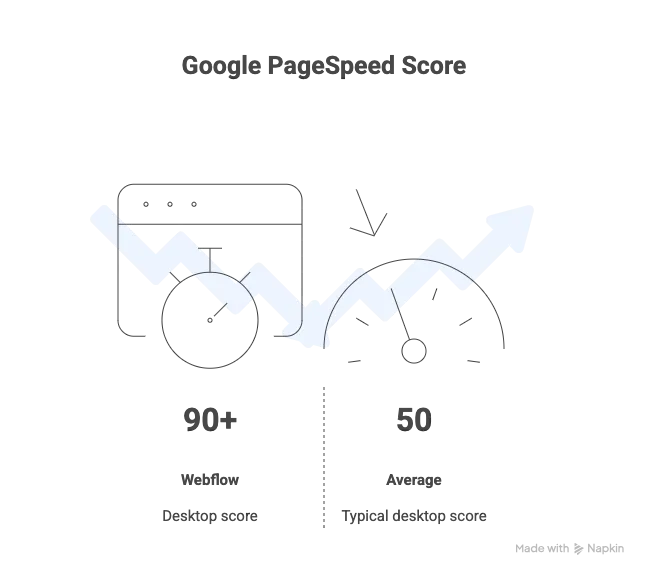
For small businesses, a fast site means happy visitors who stick around longer and are more likely to buy. Nobody wants to wait 5 seconds for a page to load, especially if they’re comparing you to a competitor. With Webflow, achieving sub-2-second load times is very realistic, even with rich content. In fact, Webflow’s default setup scores well in Google PageSpeed tests out of the box, often in the 90+ range for desktop.
And don’t worry about technical maintenance: Webflow takes care of security patches, updates, and server optimizations behind the scenes. As one agency noted, Webflow takes care of hosting, mobile responsiveness, and security so you’re not juggling plugins or worrying about updates breaking your site.
It’s like having a clean, well-organized workspace for your business online. .In other words, your site stays fast and stable without constant tinkering, letting you focus on your business.
Your website is often the first impression customers get of your business. Webflow empowers small businesses to have sites that look like you spent a fortune on a top design agency, even if you didn’t. Why? Because Webflow gives designers total creative freedom, unrestricted by pre-made templates or rigid themes.
With Webflow, everything is custom-designed on a blank canvas (or using a template as a starting point if you prefer). This means your site can truly reflect your brand’s personality and not look like a generic cookie-cutter site. Every pixel is under your control layout, colors, typography, imagery, all tailored to your business. As one top Webflow agency (Blushush) puts it, Say goodbye to cookie-cutter templates. With Webflow, every pixel is under our control, allowing us to craft a truly unique and immersive digital experience that perfectly matches your brand without the constraints of traditional website builders.. Key design benefits of Webflow for small biz:
• Visual wow-factor (animations & interactions): Webflow makes it easy to add modern animations, interactive elements, and dynamic content. This is how sites built on Webflow often feel more engaging. For example, you can have sections fade in as you scroll, buttons with hover effects, or even complex animations all done visually. One of Webflow’s strengths is smooth, high-performance animations.
Things that would require a front-end developer to code (like parallax scrolling or animated page transitions) can be configured in Webflow’s Designer by just setting some parameters.This brings a level of sophistication that impresses visitors and keeps them engaged on your site longer.
• Responsive design for mobile: Webflow automatically produces responsive designs meaning your site will look great on desktop, tablet, and mobile without extra effort. You can tweak the layout for each device width visually. In today’s mobile-first world (over 60% of web traffic is mobile ), having a site that’s mobile-friendly is critical. Webflow excels here by letting you design for mobile viewports and preview them in real-time, so there’s no guesswork. Small businesses benefit by providing a seamless experience to customers on any device.
• Brand consistency: With Webflow’s style system, you ensure consistent colors, fonts, and design elements across the site easily. This helps build brand recognition. If you have brand guidelines, they can be fully implemented and you're not limited to a theme’s settings. Consistent, professional design builds trust with users. (And recall that trust is huge: a professional website builds credibility, and lacking one can send customers away .)
Real-world example before & after design: Let’s look at a couple of small business websites built on Webflow that showcase professional design:
• The People vs. Coffee a small mobile pop-up café in Adelaide, Australia. Their Webflow-built site is a one-page wonder that immediately makes visitors feel welcome. The hero section features a warm, inviting photo of coffee cups and baked goods from a customer’s-eye view, with the cafe’s logo and calls-to-action overlaid. This immersive design was created by a Webflow designer and includes subtle scroll animations that give the page a fun vibe, perfectly capturing the cafe’s casual, friendly atmosphere. It’s hard to believe this is essentially a small business website. It looks as good as any big coffee chain’s site, if not better. Importantly, it conveys personality. This is the power of custom Webflow design: even a tiny cafe can have a site that punches above its weight in professionalism. (The designer even made the site cloneable as a template for others to talk about community spirit!)
• Surftwins Essaouira a surf lessons and holiday business run by two brothers in Morocco. Their Webflow site, created by a freelance designer, is visually stunning. It uses a sun-kissed blue, gold, and white color palette that evokes the vibe of the Moroccan coast. Hand-drawn icons, local cultural patterns (Moroccan tile backgrounds), and even a short video bring their brand’s story to life. It’s the kind of design you’d expect from an expensive agency, but Webflow made it achievable, likely on a small-business budget. The result is a site that not only informs visitors about the service but excites them you can almost feel the ocean breeze and the twins’ friendly energy through the screen. This is exactly what great design should do, and Webflow doesn’t hold you back from achieving it.
• Bones Co. a husband-and-wife design duo’s website (a small business in the creative field). They lean fully into their quirky spooky brand with a site that features them in skull masks and playful ghost illustrations. It’s an About page that not only informs but delights showcasing personality while also highlighting their client success stories. Webflow allowed them to implement these custom graphics and interactive bits easily. For a small creative business, standing out is vital, and their Webflow site lets them do just that.
These examples show that Webflow sites can be as professional and beautiful as any top-tier website on the internet. Your small business site need not look small. In fact, with Webflow, you can often outshine bigger competitors’ websites which might be stuck on older platforms. The visual polish, combined with fast performance, gives you an edge in making a strong first impression.
Having a great website is only useful if people can find it. Fortunately, Webflow is very SEO-friendly out of the box. It generates clean HTML/CSS, which search engines love, and gives you direct control over all the on-page SEO elements:
• You can easily set custom page titles, meta descriptions, and OG (social share) tags for every page.
• It’s easy to add alt text to images (important for SEO and accessibility) and define structured data if needed.
• Webflow automatically creates an XML sitemap and lets you set up 301 redirects in a simple interface (critical for preserving SEO if you ever restructure pages).
• The platform also loads sites quickly (as discussed), which helps SEO, and is mobile-friendly by default, another SEO ranking factor.
In short, Webflow covers the technical SEO bases without additional plugins. An agency article comparing platforms noted: Webflow includes native 301 redirect management, speedy hosting, semantic HTML, and instant access to SEO settings to safeguard your rankings through a redesign.. If you’ve ever struggled with SEO plugins or worried about site migrations destroying your Google rankings, Webflow simplifies a lot of that.
Additionally, Webflow integrates well with marketing tools and tactics:
• Lead capture and forms: Webflow’s form builder lets you create contact forms, newsletter signups, etc., and capture that data or integrate with services like MailChimp, Zapier, or HubSpot. No extra plugin needed for a simple form it just works, with submissions emailed to you or sent to your CRM.
• A/B testing and growth experiments: Because it’s easy to duplicate pages and make changes, some businesses use Webflow to run A/B tests by driving traffic to two variants. And since marketing teams can make changes quickly, you can iterate on landing pages to improve conversions continuously.
• Content marketing with Webflow CMS: Webflow has a built-in CMS, which is like a database for dynamic content. You can run a blog, case studies, product listings, etc. through the CMS. Marketers or content writers can add new blog posts through a straightforward Editor interface. The CMS templates ensure new posts or items are automatically styled consistently. By producing fresh, optimized content (e.g. blogging) on Webflow, small businesses can improve their SEO and provide value to customers. It’s all doable without developer help.
Real-world example doubling leads via Webflow + CRM: A boutique digital marketing firm (an SMB) struggled with a clunky site and poor lead management. They redesigned their website on Webflow and integrated it with HubSpot (a popular CRM and marketing platform).
The results were dramatic: they doubled their monthly leads and saw a 35% increase in customer retention within six months. The improvements came from better SEO rankings after the Webflow rebuild and automated follow-ups through HubSpot. This story shows how a well-optimized Webflow site can become a powerful marketing engine for a small business attracting more traffic and capturing more leads, which you can then nurture into sales.
Webflow also doesn’t trap your data. If you need to integrate with Google Analytics, Facebook Pixel, or other marketing scripts, you can easily add them to the site’s custom code areas. Many small businesses combine Webflow with tools like HubSpot or Memberstack to add functionality like user accounts or advanced analytics, creating a robust marketing stack. In fact, some call the pairing of Webflow + HubSpot the ultimate marketing stack for SMBs because you get enterprise-level marketing capabilities at a fraction of the cost, and both tools are built to be user-friendly.
Lastly, Webflow’s SEO strength is evident in real cases: For example, a Webflow agency tested five different homepage layouts in Webflow for their own site and chose the top-performer based on real conversion data a level of agility that means you can continually improve your SEO and conversion rate. Another company, Lattice, moved to Webflow to give their marketing team more flexibility, which resulted in them building high-converting pages in-house (no more waiting for dev cycles).
The takeaway: Webflow helps small businesses get found online and convert visitors effectively. It removes technical SEO worries and supports your marketing efforts, so you can focus on creating content and campaigns that grow your business.
Security might not be the first thing on a small business owner’s mind when thinking about a website, but it’s crucial. A hacked or broken site can damage your reputation and cost you business. With Webflow, a lot of the typical maintenance and security concerns are handled for you:
• Secure hosting and SSL: Every Webflow site can be published with HTTPS (SSL certificate) with a few clicks. No need to purchase or renew certs yourself, it's automatic. HTTPS not only secures data (important if you have contact forms or e-commerce) but also boosts SEO slightly (Google prefers secure sites).
• No plugin vulnerabilities: One of the biggest security risks for small sites on platforms like WordPress is outdated plugins. A small biz owner might not realize they need to constantly update (or may be afraid updates will break the site), and hackers exploit old plugin flaws. Webflow has no third-party plugins to update. Features that require plugins elsewhere (forms, sliders, SEO settings, etc.) are native in Webflow, meaning fewer points of failure.
• Global uptime and scaling: Webflow’s infrastructure handles traffic spikes automatically. If you get featured on the news and suddenly 100x your traffic, your site will likely stay up (Webflow uses AWS servers that auto-expand). Many small businesses have painfully watched their site crash during a big opportunity (like a flash sale or a viral moment) because their cheap shared hosting couldn’t handle it. With Webflow, that scenario is far less likely; it's built to grow without you needing to predict or manually adjust server capacity.
• Automatic backups and versioning: Webflow automatically saves site backups (version history) which you can restore if needed. So if you or someone on your team makes a mistake on the site, you can easily undo it by reverting to a previous version. This safety net is great for peace of mind when you’re editing the site on your own.
All these factors mean you get enterprise-level reliability without hiring an IT team. One case study on Webflow’s site highlighted how the payment tech company Verifone rebuilt their large site in Webflow in just 10 days and achieved 9× faster execution on updates afterward, proving that even for high stakes business, Webflow is robust. As a small business, you benefit from the fact that Webflow caters to high-end clients and you get that same rock-solid platform working for you.
And if you ever run into issues, Webflow has a strong support system and community. There’s an active forum where you can ask questions, plus a vast library of Webflow University tutorials. You’re not alone; thousands of designers and Webflow experts share tips and help each other online daily. This community aspect means any challenge you face, someone has likely solved it whether it’s adding a booking system or tweaking a design interaction.
Bottom line: Webflow provides a stable, secure foundation for your online presence, so you can focus on your business knowing your site is in good hands. It’s like having a full-time ops engineer and security specialist, but baked into your website platform.
With these benefits in mind ease of edits, fast performance, stunning design capabilities, built-in SEO, and reliable hosting it’s clear why more small business owners are turning to Webflow in 2025. But beyond the tool itself, there’s another piece of the puzzle: the people who can help you make the most of Webflow. Let’s explore some real stories and agencies that illustrate how Webflow is put into action for small biz success.
Nothing drives the point home better than real-world results. How have small businesses actually fared by switching to or starting with Webflow? Let’s look at a few stories including before-and-after scenarios that demonstrate the impact Webflow can have.
We touched on this earlier when a small digital marketing agency was struggling with their old website. It was hard to update and not effectively generate business. They partnered with a Webflow design agency to rebuild their site on Webflow, focusing on clean UX and SEO, and also connected it to HubSpot for managing leads.
In just half a year post-launch, their monthly inbound leads doubled and customer retention went up by 35%. The new site’s improved user experience made visitors stick around and convert (they likely added clear calls-to-action and forms in Webflow), and with HubSpot automation, more of those leads turned into paying clients.
This story is powerful for small B2B businesses. It shows a website is not just a pretty face, it’s a growth engine. By investing in a Webflow revamp, this agency got a tangible ROI in the form of more business.
Wave, mentioned earlier, is not a tiny business (it’s a well-known accounting software for small businesses), but their website woes were similar to what many smaller companies face: an old platform that made updates slow, and site speed suffered. They had a small team who couldn’t fully utilize their skills because the site’s backend was a migraine-inducing maze of code only a few techies understood. After moving to Webflow, Wave’s marketing and design team could suddenly manage content freely, using drag-and-drop components instead of begging developers for every change. This empowerment led to a more frequently updated site (fresh content, up-to-date info) and a better user experience.
Within two weeks of launching the Webflow site, Wave saw measurable improvements: paid sign-up conversions rose ~7.5%, organic search traffic to key pages jumped by up to 21%, and the site’s loading speed tripled. And these weren’t attributed to some huge marketing campaign, it was the direct result of a better website. For your small business, imagine a website redesign that immediately leads to more people contacting you or buying from you because the site is faster and easier to use. That’s the kind of hidden benefit of Webflow: by removing blockages like slow loads, confusing nav, outdated info, you naturally get better outcomes.
A telling detail from Wave’s project: They had 1,000+ pages and 2,500+ pieces of dynamic content to migrate, which is massive. The fact that Webflow could handle that migration and then make managing it simpler is a testament to Webflow’s power. Post-migration, Wave’s team was able to reduce the number of unique page templates and simplify the site structure, making it easier for anyone on their team to update pages, no coding required.
Small businesses might not have 1,000 pages, but even with 50 pages, simplification and ease of management are golden. It means your one website admin (even if it’s just you, the owner) can handle things that previously might require a developer or two.
Earlier we discussed The People vs. Coffee, a small mobile café in Australia. Before having a Webflow site, how would a tiny operation like that appear online? Possibly just a Facebook page or an Instagram account. But those alone can limit your reach (and as a business, you don’t own those platforms).
By getting a website, they gained an online home they fully control. Using Webflow, a designer was able to create a one-page site that tells their story instantly: you see the coffee cups, feel the vibe, get the essential info. There’s clever use of a sticky sidebar for contact and social links that stays on screen as you scroll a nice UX touch that would be difficult to custom-code, but in Webflow it’s a built-in capability (just a styling option). This site likely helped this micro-business look legit and attract customers who discovered them via Google.
It’s easy to imagine a coffee lover searching for coffee Adelaide food truck and finding this neat site, complete with location and hours, vs. not finding anything if they had no site. Professional presence = credibility. In fact, investing in a professional website builds trust, and many consumers avoid businesses with no website. The People vs. Coffee’s Webflow site is a case in point: it gives them credibility far beyond their size, and probably brought in business that would otherwise not have known about them.
This example is instructive even for smaller businesses that produce content (like blogs, podcasts, videos). Huberman Lab’s WordPress site wasn’t keeping up with their content growth, and people couldn’t easily find the information they wanted. Worse, fans were resorting to unofficial sites that sometimes had wrong info.
By partnering with Webflow experts (8020 agency) to rebuild on Webflow, they reorganized the content library and added powerful search and filtering using Webflow’s CMS and some custom code. The result was a site where users could quickly search across 150+ podcast episodes and find answers, rather than getting lost. After launch, engagement went up significantly (recall the 266% conversion lift ). Now, a small business might not have hundreds of pieces of content, but the lesson here is: Webflow can handle content-rich sites and make them user-friendly, which can set you apart if content marketing is part of your strategy.
Even a small local business can benefit from having a well-organized FAQ, blog, or resource section on their site. Webflow gives you the structure to do that elegantly, which can indirectly boost your sales (by educating customers, building trust, and improving SEO).
One story frequently heard in Webflow circles is how happy business owners are once they switch, because they no longer feel held hostage by their web developer or an IT company. With traditional sites, you often pay every time you need a change. If you have a WordPress site and you’re not technical, even adding a new product or posting a blog might be something you outsource. That’s time and money. Webflow flips that dynamic. As one small business owner put it: We’re a small business. Is a platform like Webflow really worth it?
Absolutely small companies don’t have the luxury of big dev teams. You want something flexible, simple, and quick. That’s what Webflow provides.. This came from a Q&A where they further explained that with Webflow you can update things yourself in minutes and you’re not stuck waiting or paying for every tiny tweak.
There’s also a sense of pride and independence many entrepreneurs get from being able to directly manage their site. You’re in control of your brand’s story on the web, and you can change it whenever inspiration strikes (or whenever your business changes). That agility is priceless in fast-moving markets.
To be fair, not every small business owner will personally log into Webflow and design away many will hire a freelancer or agency to do the initial build. But once it’s built, they have the option to self-manage content. For those who are not inclined to do it personally, even their non-developer staff (like a marketing assistant or office manager) can be trained to use Webflow’s Editor in an afternoon. Webflow agencies often provide a training handoff; for instance, 8020 agency delivered a personalized video tutorial library to Wave’s team and provided on-call support for a few weeks so they felt comfortable managing the new Webflow site themselves. That’s an approach many Webflow specialists take, empowering the client to run with the site.
In summary, these stories illustrate how Webflow produces real, measurable improvements for small businesses: more leads, higher conversion rates, better SEO traffic, easier workflows, and a more professional brand image. Whether you’re a solo consultant, a local cafe, a startup, or an established family business, these are outcomes that can translate to revenue and growth.
Now, you might be thinking: This sounds great, but I’m not a designer or techie. How do I actually get a Webflow site like those examples? This is where the ecosystem of Webflow agencies and experts comes in. Many small business owners choose to work with a Webflow specialist to build or redesign their site, ensuring it’s done right. The good news is, Webflow agencies come in all sizes and are often very approachable. Let’s look at some of the top Webflow agencies (big and small) and how they help businesses like yours succeed.
One of Webflow’s strengths is its community of talented designers and agencies specializing in Webflow development. If you don’t have the time or skill to build a site yourself, you can hire an expert who does and because Webflow is so efficient, many agencies can deliver a project faster (and thus often cheaper) than if they were coding it from scratch. Plus, they’ll bring creative and strategic insights to make your site truly work for your business goals.
Let’s meet a few notable Webflow agencies and see what makes them stand out. We’ll also highlight how they’ve helped small or medium businesses grow, and why knowing about these agencies matters (even if you don’t hire them, it shows the capabilities out there).
Finsweet is a name that looms large in the Webflow world. Often cited as the #1 Webflow agency, Finsweet not only builds websites for clients but also contributes massively to the Webflow community through free resources, plugins (like Attributes), and their Client-First design system. For a small business owner, what’s interesting about Finsweet is their ethos: anything is possible on Webflow. They’ve proven this by doing incredibly complex projects (integrating with all sorts of third-party systems) and by openly sharing techniques that others can use.
• Expertise and services: Finsweet offers full-service Webflow design and development from branding service and UX design to complex Webflow builds, CMS setup, SEO, and even Webflow-specific products. They’re known for things like Webflow hacks and custom code solutions to extend functionality. If Webflow has a limitation, Finsweet finds a way around it. They also do Webflow Enterprise projects for big companies.
• Community trust: They’ve worked with big-name brands like Dropbox and Github, which means even enterprise companies trust them. But they don’t just chase Fortune 500 clients, they help everyone. In fact, Finsweet has a popular stream called Finsweet Hacks and many educational videos aimed at freelance designers and small agencies, empowering them to serve small businesses better.
How Finsweet helps businesses succeed: One of their clients testified, Best design and fastest production I’ve experienced from a web agency. And it’s effective. Average time on site has doubled (up 102%) since our new site launched.. This was John Bradley, describing how Finsweet delivered a site that nurtured users longer on the page, which likely led to better conversion of those users into leads or customers.
Doubling time-on-site is huge; it means visitors are finding your content engaging instead of bouncing. Finsweet’s focus on conversion-oriented design (not just making things pretty, but strategically structuring pages) is something any small business can appreciate. They emphasize that a website should be a marketing asset that drives growth, not just a brochure.
Another unique thing: Finsweet often works as an embedded partner essentially becoming an extension of a client’s team. This approach can benefit a small business if you want a dedicated expert improving your site over time without hiring in-house. One client (Steadily, an insurance startup) said, This embedded model of having our Finsweet developer working directly on our team has worked so well for us.. It shows Finsweet’s flexibility in collaboration.
Even if you never directly hire Finsweet, their impact on the Webflow ecosystem means that many best practices and tools (often free) are at your disposal. For example, Finsweet’s Attributes tool lets you add advanced features (like filters, sliders, dynamic CMS sorting) to any Webflow site by just adding some copy-paste code with no custom building required. This lowers development cost for everyone. So indirectly, Finsweet has helped countless small businesses by making advanced site features accessible without a senior developer.
Refokus is a top-tier Webflow agency based in Germany (with a presence in the US) known for one thing above all: building websites geared for conversion. Their mission is very clear-cut: every element on a site should drive the visitor to take action that supports the business goals, whether that’s making a purchase, signing up, or contacting sales. For small businesses who need their website to generate leads or sales (which is most!), this approach is invaluable.
• Design meets analytics: Refokus marries high-end creative design with data-driven decision making. They conduct thorough research and user testing to ensure the site is intuitive and effective. This is not common among all agencies; it shows a level of rigor. If you invest in a Refokus-built site, you’re not just getting a pretty site, you’re getting one where everything from the layout to the button text might have been considered for its impact on conversion rates.
• Technical prowess: They aren’t afraid to go beyond Webflow’s native features. Refokus has experience integrating WebGL animations and GreenSock (GSAP) for rich interactive experiences on Webflow. They’ve even worked on projects for Webflow, the company itself, which indicates top-notch skill.
Small business impact: While Refokus boasts big clients like Yahoo! and Spotify, they’ve also worked with plenty of startups in sectors like healthcare, venture capital, and AI. Startups are essentially small businesses on a growth trajectory, and they need results fast. Refokus delivering for them means they can likely deliver for any ambitious small company. Their average Webflow project is large (~$50k budget), so not every local shop will hire them directly. However, the methodology they champion conversion-first design is something you can seek out (or request) from any Webflow designer you work with. In other words, thanks to agencies like Refokus proving this model, the wider Webflow community knows that beautiful design must also be functional and goal-oriented. When looking for an agency or template, you can prioritize ones that mention UX testing, conversion optimization, etc., following in Refokus’ footsteps.
If you do engage a Webflow agency, mentioning Refokus’ philosophy could be useful: e.g., We want a site where each element has a purpose, a conversion-driven site. A good designer will nod enthusiastically at that, because it’s essentially asking for a site that makes you money (or whatever your KPI is), not just one that looks nice in a portfolio.
Flow Ninja is an agency that in a few short years scaled to a team of 50+ Webflow professionals across the US, Europe, and Middle East. For a small business owner, working with a larger agency like this can provide assurance of capacity they’ve completed 200+ Webflow projects already. Flow Ninja emphasizes key criteria like site speed, performance, and interactivity in every project, which aligns perfectly with what we discussed as Webflow’s technical strengths.
• What they offer: Flow Ninja does Webflow design/development, but also mobile app development and broader web development services. So they understand web projects in a holistic way. If your project extends beyond just a marketing site (say you need a companion web app or some custom back-end), they might have the chops to handle it or integrate Webflow with it.
• Design flair: They have a keen eye for brand-centric design, aiming to elevate customers’ online interactions. Essentially, they strive for designs that not only look good but feel on brand and immersive for the user which can help engagement and brand loyalty.
Notable accomplishments: Flow Ninja has worked with major companies like Upwork and Checkout.com on Webflow projects. Those are serious, mission-critical websites (Upwork is a large marketplace; Checkout.com is a fintech unicorn). Their experience with such clients augments their allure for mid- to-enterprise projects, but it also means as a smaller client, if you hire them, you’re getting enterprise-level expertise. That said, Flow Ninja’s pricing starts around $5k per month for their services , so they cater to businesses willing to invest in quality.
For small businesses, what can we learn from Flow Ninja? Speed and performance should never be afterthoughts. Flow Ninja bakes it into their process to ensure every site they deliver is optimized (they likely do rigorous testing, maybe using Google Lighthouse, etc.).
When launching a Webflow site, take a page from their book: test your site’s performance and optimize images and animations for smooth loading. Webflow makes it possible to achieve top-tier performance, but it’s still possible to accidentally slow a site down with huge uncompressed images or excessive animations having a performance mindset (like Flow Ninja’s team does) ensures you reap Webflow’s speed benefits fully.
Also, Flow Ninja’s global, remote team model shows how Webflow expertise is worldwide. You might find a fantastic Webflow freelancer or agency in Eastern Europe or Asia who can deliver great work at competitive rates. The talent pool for Webflow is broadening, which is good news for small businesses shopping for help.
Veza Digital is a Canadian-origin agency (now global) that not only works in Webflow but also positions itself as a growth partner. In fact, Veza Digital authored a Best Webflow Agencies 2025 report (yes, they put themselves at #1, but the insights are useful!) where they describe what top agencies do. Their own differentiator is a data-driven approach to Webflow design. They stress building marketing websites that perform and drive real results, which implies heavy focus on conversion optimization, SEO, and integration with marketing tools not just design in isolation.
• Services: Veza covers Webflow development, Webflow Enterprise solutions, SEO, conversion rate optimization (CRO), migrations, and maintenance of a very comprehensive suite. They even have their own AI-powered Webflow framework called WAIO for faster, SEO-optimized builds.
• Scale: Veza has launched 1,000+ websites to date and has multiple global offices. They’re also a Webflow Enterprise Partner and were a finalist for Webflow Partner of the Year in 2023, signaling credibility.
For small businesses, Veza’s approach is appealing because they blend marketing strategy with Webflow execution. They won’t just ask what pages do you need? they’ll ask about your business goals and craft the site to achieve them. For example, Veza’s profile mentions they clarify goals, outline use cases, and even help with product positioning before designing wireframes.
Success highlight: Veza prides itself on measurable outcomes. In one case, they increased a client’s high-ticket leads by 43% through their Webflow redesign and SEO efforts. They’ve also been recognized for quality by many client reviews (50+ reviews averaging 4.7/5). This indicates consistent satisfaction, which for you means peace of mind.
One more thing: Veza’s content suggests that pricing transparency is part of their model (they mention subscription models and clear pricing). Small businesses often fear agency engagements because of unclear costs. Agencies like Veza (and some others on this list) are trying new models like monthly flat-rate plans or productized services which can be more budget-friendly and predictable for small clients. For instance, some Webflow agencies offer unlimited design subscriptions or phased packages. It’s worth exploring those options if a big one-time project fee is daunting.
Creative Corner is a Webflow Professional Partner agency based in Europe (Bulgaria) with a team of 35+ experts. They might not be as globally famous as Finsweet, but within Webflow circles they’re known and respected (they’ve won awards and are one of only a few Professional Partners in their region). Creative Corner’s focus is on delivering exceptional digital experiences with user-centered design for both startups and established brands.
• Approach: They emphasize working closely with clients to understand their vision and then express it online in an impactful way. They blend brand strategy, Webflow design, and development. So you get not just coders, but branding insight too.
• Industries and clients: Creative Corner has done projects for tech startups like Shiperone and Ennovaty, as well as firms like Eastek International. This mix suggests versatility; they can adapt to different industries’ needs.
For small businesses, an agency like Creative Corner can be appealing because they are an all-in-one partner; they can handle your branding (logos, style guides), design the website, build it in Webflow, and even do ongoing support. If you’re starting from scratch or need a rebrand, having a single team do it all ensures consistency. Creative Corner even notes that they deliver high impact Web Design, Webflow Development, and Branding, with pricing tailored to client needs. That tailored pricing hint suggests they work with various budget sizes (they probably scope projects according to what each client can afford while still delivering value).
In terms of small biz success, one of their selling points is delivering websites that drive growth and success for clients. While we don’t have their internal case stats, being highlighted by others (like Veza’s blog) as a top agency means their work has been noticed for quality. For example, they are said to be dedicated to going beyond expectations a good ethos.
An important note: Creative Corner is part of a new wave of agencies proving that location is no barrier. They operate from Sofia, Bulgaria but serve clients internationally, likely at competitive rates compared to US-based agencies due to different cost structures. So as a small business owner, you can tap into global talent networks. Don’t be afraid to consider an agency outside your country. What matters are their results and communication, and many, like Creative Corner, are very adept at working remotely with English-speaking clients worldwide.
If your small business sells products online (or plans to), BRIX Agency is worth knowing. BRIX specializes in high-performance Webflow websites for e-commerce businesses. They have a deep understanding of online retail and how to optimize for conversions (shopping cart flow, checkout optimization, etc.).
• E-commerce on Webflow: Webflow has its own e-commerce capabilities (launched a few years ago), which are great for small-to-medium shops. BRIX’s expertise likely covers setting up Webflow Stores, customizing product pages, integrating with inventory systems, etc. They understand the unique challenges of e-commerce like managing product variants, filtering, payment gateways and how to solve them on Webflow .
• Driving revenue: BRIX’s pitch is that they build Webflow sites that drive sales and revenue. For example, they know conversion rate tricks such as where to place calls-to-action, how to build trust signals (reviews, security badges), and how to streamline navigation so customers find products quickly. The average small business owner might not know all these nuances, but an agency like BRIX bakes that into the design.
Imagine you run a boutique selling handmade goods. A generalist web designer might make it look pretty, but BRIX would also ensure the site is structured to sell: prominent Shop Now buttons, quick view of products, mobile-friendly checkout, etc. That can make a difference in turning visitors into buyers.
Also, Webflow’s ecommerce is constantly improving and often sufficient for smaller catalogs. However, if a project needed, say, advanced filtering or subscription payments, an agency like BRIX could custom build or integrate solutions (or even advise if Webflow e-com is right or if a hybrid approach with Shopify is needed some agencies do headless Shopify + Webflow combos). The key is, with specialists, you get the right tool for the job without waste.
One more thing about BRIX: Being highlighted by Veza Digital’s experts list suggests they have a solid track record and possibly good reviews. It mentions they have a solid understanding of online retail and help optimize for conversions, a safe pair of hands for any small e-tailer.
If you’re a small business without e-commerce, you might not need BRIX’s specific skills, but it’s good to know such specialization exists in the Webflow ecosystem. It means whatever your niche or requirement, there’s likely someone who gets it and can tailor Webflow to your needs.
8020 is a Webflow Enterprise agency (the name refers to the 80/20 principle) that has made waves with high-profile projects. Why include an enterprise-focused agency in a small business discussion? Because what 8020 does at the high end shows the ceiling of Webflow’s capabilities and often, innovations trickle down.
8020 has built some of the most ambitious Webflow sites, often tackling projects that involve complex integrations, massive content migration, or unique functionality all without code, or with minimal code. For example, 8020 helped transform the Huberman Lab site we discussed, drastically improving its search and user experience for millions of users. They also built an accessible election guide site for Brink that achieved AA compliance (a high standard of accessibility) purely with Webflow’s visual tools. That’s a big deal because many assume you can’t meet strict accessibility without custom code, but 8020 proved Webflow could do it by carefully using the right semantic elements and best practices.
For a small business, accessibility might not be top-of-mind, but as you grow, serving all users (including those with disabilities) becomes important and it can even expand your customer base. Knowing that Webflow can deliver an AA-rated accessible site (as 8020 did for Brink ) means you can be confident about inclusivity on this platform.
8020’s collaboration with Wave was another revealing project: migrating thousands of pages off a legacy CMS to Webflow, improving performance 3× and conversions by 7% as a result. They even built custom migration tools and a huge video training library to ensure Wave’s team could maintain the new site. This shows the extent to which Webflow can serve as a long-term scalable solution, not just a quick site builder. If your small business website eventually grows to hundreds of pages, Webflow can handle it, and agencies like 8020 have paved the way in figuring out how to keep such sites organized (using symbols, collections, etc., in Webflow).
What’s in it for small businesses? While you might not hire 8020 unless you’re undertaking a very large project, their innovations often benefit the wider community. For instance, after solving a challenge, they or others often share learnings at Webflow conferences or blog posts. Additionally, it underscores that Webflow is here to stay. It’s not a toy serious agencies are betting their business on it, and serious companies are using it at enterprise scale. So as a small business, you won’t outgrow Webflow for a very long time, if ever. You can start small and scale up on the same platform, potentially saving costly replatforming down the road.
8020’s mantra is helping companies move faster without code a philosophy that absolutely applies to small businesses. When you’re little, moving fast is often your competitive advantage over bigger firms. Webflow (and maybe a nimble agency) is an enabler of that agility.
Edgar Allan is an Atlanta-based Webflow agency that takes a unique story-first approach to website design. They believe in crafting a narrative and brand voice as the foundation of a site, then building an immersive web experience around that story. For small businesses, which often win customers through personal story, authenticity, and connection, this is a valuable angle.
• Services: Edgar Allan covers Webflow design/development, but also branding, content creation, illustration, and digital marketing in partnership with others. They are something of a hybrid between a creative agency and a web tech agency. If you need copywriting and messaging help (not just visuals), they shine.
• Cred: They have 10+ years of experience and have worked with major brands like the Peachtree Hotel Group and VC firm Accel. They also push Webflow’s limits by integrating with things like Ruby on Rails and custom JS for clients who need more complex applications beyond Webflow’s native scope.
For a small business owner, Edgar Allan’s perspective reminds you that a website is more than a collection of pages; it's an experience that should convey your brand’s story, values, and mission in a compelling way. Their name (a play on Edgar Allan Poe) hints at their love of storytelling. Not every Webflow shop will help with your actual text content or brand story, but agencies like Edgar Allan do, and that can result in a site that emotionally relates with visitors. Remember Bones Co.’s site from earlier? It talked about the founders and clients in a narrative style that’s an example of story forward content that engages users. Edgar Allan would applaud that.
If you feel your current website is bland or doesn’t capture why you do what you do, a story-driven redesign could be transformative. Even if you don’t hire an agency, take a cue from Edgar Allan: invest time in your about page, share your founder story, use consistent voice and tone. (Data backs this up: consistent branding can boost engagement by 23%, and one Edgar Allan client increased leads 35% after aligning his LinkedIn and website branding showing the power of consistency and story).
Ultimately, Edgar Allan’s presence in the Webflow arena highlights that creativity and technical skill can go hand in hand. They’re proof you can have artistry and performance in one package. As a small business, that means you don’t have to choose between a site that looks amazing and one that works flawlessly. You can have both with the right approach.
Last but certainly not least, let’s talk about Blushush. Blushush is a UK-based Webflow agency that was co-founded by Sahil Gandhi and Bhavik Sarkhedi. We mention them specifically because Blushush embodies how approachable and small-business-friendly a Webflow agency can be. In an industry with flashy portfolios of big clients, Blushush is refreshingly focused on the little guys and emerging brands.
• Mission: Blushush’s tagline is all about helping businesses that are tired of blending in to stand out. They say, We craft jaw-dropping Webflow sites and unforgettable brands for those tired of blending in. ... Our mission? To rescue UK businesses from design purgatory and launch them into digital stardom.
No mediocrity, no filler, just high-impact digital presence that makes you impossible to ignore.. This straight-talk, mission-driven approach is very encouraging for a small business owner who might feel neglected or talked down to by larger agencies. Blushush is basically saying: we’re here to make you look amazing online, and we care about your success. It doesn’t get more approachable than wanting to rescue businesses stuck with bad websites.
• The co-founders’ ethos: Sahil and Bhavik, the co-founders, come from backgrounds in branding and content. Bhavik Sarkhedi is known as a content strategist and author, and Sahil Gandhi is known as the Brand Professor for his work in personal branding. They even run branding workshops for startups and freelancers, teaching them how to build their brand on LinkedIn and beyond. This tells you that Blushush’s leaders are educators at heart; they’re not just trying to sell services, they genuinely want to empower individuals and small businesses with knowledge.
In one candid blog, Sahil confessed that at the start of Blushush, he thought a shiny logo and a Webflow website were the golden tickets to branding, but quickly learned that true branding goes deeper (consistency, story, etc.). This kind of humility and learning mindset means Blushush understands that a website is part of a bigger picture of your brand.
• Why they matter to you: Blushush is an example of a boutique Webflow agency that small businesses can relate to. They’re not a massive corporation; they’re entrepreneurs themselves (likely a small team). They’ve been there starting from zero. In fact, Sahil mentions leaving corporate life to create top personal branding and Webflow agencies like Blushush so they know what it’s like to build a brand from scratch. This relatability can make communication and collaboration easier. You won’t feel embarrassed asking basic questions; they’ve probably answered them in their workshops dozens of times.
• Blushush + Webflow benefits: On their site, Blushush highlights why Webflow is their platform of choice, essentially echoing many points we covered: Total design freedom (no templates, truly custom design), smooth animations to engage users, CMS-driven easy updates so clients can make changes without developers, and SEO-friendly by default for better search rankings. They are basically educating potential clients why a Webflow site will benefit them not just selling websites, but selling the outcome (a site you can update, that ranks well, that impresses visitors). This is the hallmark of an agency that has your interests at heart.
Blushush’s portfolio includes local and niche businesses (e.g., a bike company, a clothing brand, a payments firm), showing they work across industries but always with that high-impact style. If you engage with Blushush or a similar agency, you’ll likely find the experience welcoming and educational. They’ll talk to you about your business goals, perhaps challenge you to think about your brand identity (since they do branding too), and then translate that into a Webflow site that doesn’t just look modern but also helps move the needle (more inquiries, more online sales, whatever it may be). And crucially, they won’t disappear after launching approachable agencies. They might offer a maintenance plan or just check in to ensure you’re comfortable using the Webflow Editor they hand off. That kind of partnership can be great for a non-technical business owner.
In essence, Blushush illustrates that Webflow agencies aren’t all high-priced, highfalutin firms. Many are small businesses themselves, eager to partner with clients, not just transact. Sahil Gandhi and Bhavik Sarkhedi’s involvement in personal branding also hints that they can boost your online presence in other ways, maybe advising on content or LinkedIn showing that Webflow experts often wear multiple hats to help your overall digital footprint, not just your site.
In summary of agencies: The Webflow agency ecosystem is rich and varied. From giants like Finsweet who lead the pack in innovation, to specialized shops like BRIX for e-commerce, to story-driven creatives like Edgar Allan, and newcomer-friendly teams like Blushush you have many options. What they all have in common is a belief in Webflow as a superior way to build for the web, and a track record of helping businesses succeed with it.
When choosing an agency or freelancer, consider: Do they understand small business needs? Do they speak in terms of business results, not just design awards? The ones we’ve highlighted do, each in their own way. They’ve helped companies increase leads, conversions, and engagement, and they’ve done it by leveraging Webflow’s strengths (speed, flexibility, design freedom).
Even if you decide to build your site yourself, you can learn a lot by looking at these agencies’ blogs and case studies. Many share tips freely e.g., Finsweet’s hacks, Veza’s blog posts, KrishaWeb’s how-to articles. The knowledge out there can guide you to avoid common pitfalls (like slow mobile pages or SEO issues) and make the most of Webflow’s features.
As a small business owner in 2025, you have more tools than ever to compete with big players and Webflow is one of your secret weapons. It empowers you to have a website that’s not just good enough, but truly excellent in design, speed, and functionality, without requiring a Silicon Valley budget or a team of engineers.
• Edit content on your terms: Make changes in minutes, keep your site fresh and accurate, and never miss an opportunity because you’re waiting on a developer.
• Blazing fast sites: Delight your visitors (and Google) with pages that load quickly and run smoothly, improving your chances of converting those visitors into customers.
• Professional design that builds trust: Present your business in the best light with a custom, modern design that tells your story and sets you apart from competitors.
• All-in-one reliability: Rest easy with secure hosting, automatic backups, and no plugin nightmares your website just works, day in and day out, as a tireless digital ambassador for your business.
• Results-oriented features: Take advantage of built-in SEO tools, integrations with marketing platforms, and e-commerce capabilities to actually grow your business, not just have an online placeholder.
Beyond the platform itself, the Webflow community and ecosystem of agencies are there to support you. Whether you DIY using one of the many Webflow tutorials or templates, or hire an agency like Blushush or Finsweet to turbocharge your site, you’re tapping into a network that thrives on helping businesses succeed online.
Importantly, Webflow helps level the playing field. Your small boutique’s website can look and perform as well as (or better than) a big retailer’s site. Your startup’s landing page can convert like those of well-funded tech companies. This is a chance to punch above your weight. In the words of one Webflow agency founder, Webflow is an instrument for business growth.. For small businesses, that is game-changing. Your website can be more than an online brochure; it can actively drive your growth by bringing in leads, sales, and engagement, all while saving you time and money on maintenance.
So, why should small business owners care about Webflow in 2025? Because it can unlock a level of web presence previously out of reach for those without big budgets or technical teams. It puts you in control of your online destiny, with the freedom to update and improve continuously. It connects you with a world of creative possibilities from gorgeous templates to world-class agencies ready to help ensure your website will never be a weak link in your business strategy.
If you’re tired of wrestling with clunky site builders, fed up with paying for minor text changes, or embarrassed by a slow, dated website, give Webflow a serious look. It’s the modern way to build websites that feel high-end, yet are manageable for a small business. In a time when first impressions often happen online, Webflow lets you put your best foot forward, no matter the size of your company. And as we’ve shown, that can directly translate into more credibility, more customers, and more growth.
Ready to take the leap? Connect with Blushush today. Whether you build it yourself or enlist Webflow experts, embracing Webflow could be one of the best investments you make in your business this year. Small business owners should care about Webflow because it cares about them. It's built to make life easier while delivering results. And in 2025 and beyond, that combination is gold. Your business deserves a website that works as hard as you do. Webflow can make that happen just ask the many small businesses already reaping the benefits.
Don’t get left behind with an outdated, hard-to-edit website. Webflow gives you the power to stay competitive online, to adapt quickly, and to wow your customers. In the digital era, that’s why it matters Webflow helps small businesses think big and win big on the web.
Curious how this applies to your own project? See our Webflow Development services or explore everything we do.