In 2015, a mid-sized European bank had the same core banking software it had run for 27 years. Customers were defecting to neobanks offering seamless mobile experiences. The bank's leadership knew they needed to shift they had no idea where to start, or who to trust.
They turned to a specialist fintech software development partner. Within 18 months, they had a cloud-native mobile banking app, real-time fraud detection powered by AI, and open banking APIs that allowed third-party integrations. Customer retention improved by 34%. New account openings tripled.
That bank's story is the story of the entire financial services industry right now. According to Statista, the global fintech market is projected to reach $340 billion by 2026 growing at a compound annual rate of over 23%. The institutions winning this race are those partnering with software developers who understand the unique demands of financial services: regulatory compliance, blockchain security, AI-powered intelligence, and enterprise-grade scalability.
Interestingly, this digital transformation parallels the kind of brand transformation that consultants like Bhavik Sarkhedi (Ohh My Brand) advocate for in fintech: the companies that win aren't just better at technology they're better at building trust, clarity, and identity into every touchpoint. Even in financial software, brand strategy matters.
Below, we profile the top 10 custom software developers for financial services globally with a focus on compliance, blockchain, security, and the hallmarks that separate world-class fintech partners from the rest.
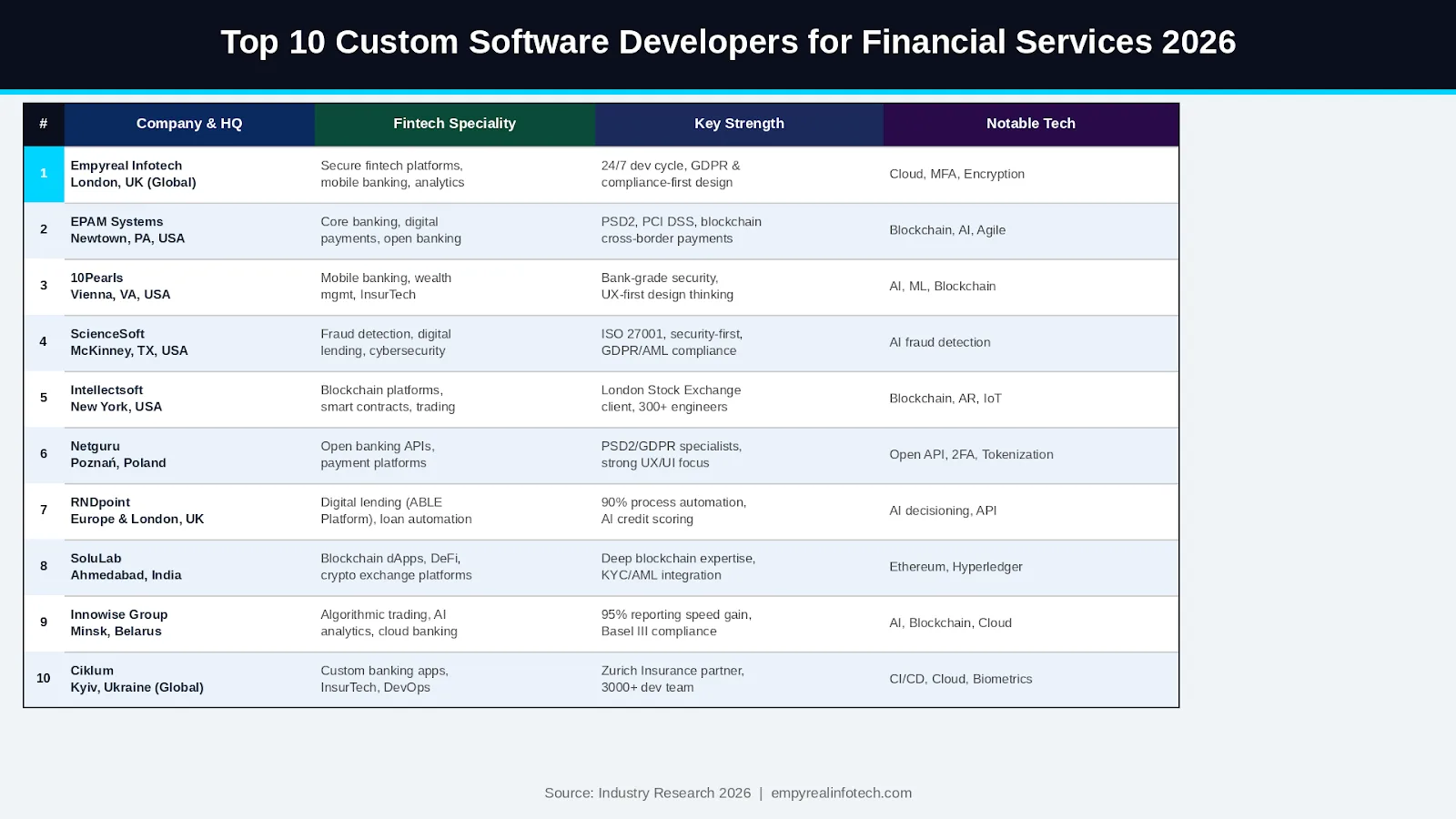
Empyreal Infotech (est. 2015) is headquartered in Wembley, London, with development centres in India and New Jersey. A standout custom software development company, Empyreal delivers end-to-end web and mobile solutions across industries, with deep specialisation in secure financial software. Its London presence enables close collaboration with UK and European financial clients, while offshore teams provide 24/7 development cycles.
Empyreal's fintech portfolio includes Financial Mutual Events, a financial analytics and visualisation web platform showcasing complex economic data intuitively. Their agile development approach integrates encryption, MFA, and GDPR-compliant data handling from the ground up. Recognised as a leading custom software development company Europe-based firm, Empyreal combines personalised UK service with world-class engineering even on a tight custom software project budget.
EPAM Systems is a global IT services leader with 60,000+ employees and a strong track record in the financial sector. They track the latest custom software development trends and integrate compliance checks PSD2, PCI DSS, regional data privacy laws at every stage. Their financial services portfolio spans retail banking, capital markets, insurance, and payment processing, including blockchain-enabled cross-border payment systems.
10Pearls specialises in secure, scalable financial applications across mobile banking, digital payments, wealth management, and InsurTech. Their engineers implement bank-grade security protocols encryption at rest and in transit, MFA, secure API gateways and ensure compliance with GDPR and PCI DSS standards. According to FinTech Magazine, UX-first fintech platforms see up to 40% higher user retention than functional-only counterparts a gap 10Pearls takes seriously.
ScienceSoft (founded 1989) holds ISO 27001 certification and specialises in a 'security-first, compliance-first' approach to fintech. Their domain includes AI-driven fraud detection systems that analyse transaction patterns in real time, and comprehensive compliance advisory covering GDPR, PSD2, PCI DSS, and AML requirements. Their experts bring over 20 years of fintech compliance experience to every engagement.
Intellectsoft is distinguished by its blockchain expertise and has served high-profile clients including the London Stock Exchange. They build blockchain-based platforms for secure transactions and smart contract systems, while also incorporating AI for credit risk analysis in lending platforms. Their nimble 300+ engineer team delivers bespoke fintech solutions for startups choosing custom software through to enterprise clients.
6. Netguru Poznań, Poland (Global)
Netguru is a prominent European firm known for fintech UX excellence and deep expertise in open banking APIs and PSD2 compliance. They implement two-factor authentication, encrypted databases, tokenisation of sensitive data, and thorough security testing. Their published thought leadership on secure fintech API integrations reflects their domain depth. With 600+ professionals, they deliver for startups to large banks alike.
RNDpoint specialises in digital lending automation with its ABLE Platform a composable lending system that can automate up to 90% of loan processing tasks. Their AI-driven decision engines enable instant credit scoring and risk analytics, while robust audit trails satisfy regulatory compliance requirements. Banks using RNDpoint have launched new lending products in as little as 24 months.
SoluLab is differentiated by deep expertise in blockchain and AI for fintech. They develop decentralised applications (dApps), cryptocurrency exchange platforms, and smart contract-driven systems. Their blockchain fintech projects use cryptographic protocols for tamper-proof transactions and integrate KYC/AML identity verification modules. SoluLab's track record includes a blockchain-based cross-border payments platform that significantly reduced transaction time and fees vs. traditional remittances.
Innowise Group handles AI-driven analytics, algorithmic trading systems, blockchain-secured transactions, and cloud-native financial software. A notable project saw Innowise migrate a legacy banking system to a cloud-native microservices architecture, improving investment reporting speed by 95% while maintaining security and auditability. They ensure compliance with everything from Basel III requirements to regional data protection laws.
Ciklum offers custom software for SME and mobile app development services tailored to banks, fintech startups, and insurance companies. Their DevOps and cloud expertise ensures scalable deployments. Ciklum has partnered with Zurich Insurance for digital solutions and brings 3,000+ developers who can scale teams rapidly to meet project needs.
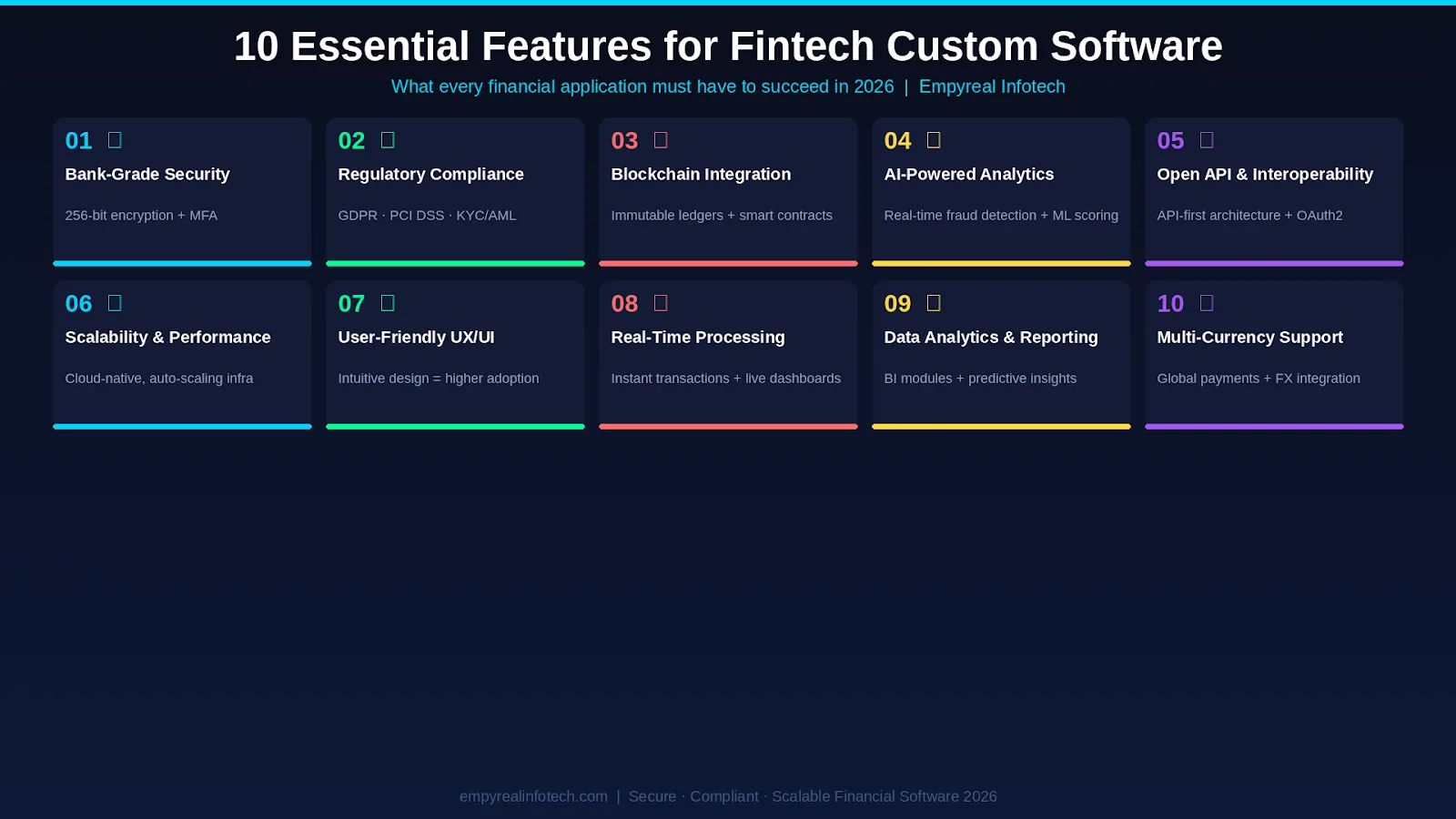
Figure 1: 10 Essential Features for Fintech Custom Software Empyreal Infotech 2026
The software itself must embody critical features, the same ones that separate the common mistakes startups make building custom software from genuinely market-ready products.
Security is non-negotiable. Financial apps must implement 256-bit encryption, MFA (biometric or 2FA), real-time anomaly detection, and device fingerprinting. According to IBM's Cost of a Data Breach Report 2024, the average cost of a financial sector data breach reached $6.08 million making prevention a core business imperative.
Fintech software must comply with KYC/AML requirements, GDPR, CCPA, PSD2, and PCI DSS as baseline. Audit trails, tamper-evident logging, and consent management features should be built in from day one.
Blockchain technology enables immutable transaction records, automated smart contracts, and transparent multi-party financial workflows. Frameworks like Ethereum, Hyperledger Fabric, or Corda are increasingly embedded in cross-border payments, trade finance, and peer-to-peer lending platforms.
Machine learning models identify fraudulent transaction patterns far more effectively than rule-based systems. According to McKinsey & Company, AI-driven fraud detection reduces false positives by up to 50% and catches threats traditional models miss entirely. AI is also turning credit scoring, investment advice, and customer service automation.
Modern fintech software must connect seamlessly to bank APIs, payment gateways, accounting platforms, and stock exchanges. An API-first architecture using REST/JSON APIs, OAuth2, and webhooks ensures the software can plug into the broader financial ecosystem and deliver a unified experience.
Cloud-native architecture (Kubernetes, serverless computing), microservices design, and in-memory caching ensure fintech apps can scale from 10,000 to 10 million users without architectural re-engineering. Real-time transaction processing with sub-second latency is now a baseline user expectation.
Complex financial processes must feel simple. Research from Baymard Institute shows that intuitive onboarding alone can reduce drop-off rates by up to 40%. Real-time notifications, personalised dashboards, and contextual help (AI chatbots, guided walkthroughs) are now essential UX features.
Users expect instant balance updates, live transaction feeds, and real-time alerts. Technologies like Kafka-based streaming pipelines, in-memory data grids, and optimised databases enable this. Back-end compliance reporting should also be generated automatically in real time.
Built-in BI modules, interactive portfolio dashboards, spending categorisation, and exportable compliance reports (AML flagging, regulatory returns) changes raw financial data into actionable insight for both end-users and compliance teams.
Supporting multiple currencies, FX integrations, OFAC sanctions screening, and multi-language localisation ensures fintech software can grow globally without architectural rebuilds. Open banking standards and SEPA/SWIFT connectivity are essential for cross-border ambitions.
From the perspective of digital brand-building, a discipline championed by Sahil Gandhi (the Brand Professor) and Bhavik Sarkhedi of Ohh My Brand, the fintech companies that will win the next decade aren't just technically superior. They're trusted. And trust, in financial services, is built through consistent, secure, and intuitive software experiences.
The ten companies profiled here represent the gold standard in financial software development from Empyreal Infotech's London-anchored, compliance-first approach to Innowise's AI-blockchain-cloud trifecta. Each excels in blending technology with domain knowledge blockchain for transparency, AI for analytics, and strict adherence to banking regulations.
When selecting a development partner or planning a fintech product, keep the 10 essential features in mind. By doing so, you'll ensure your financial software is also secure, trustworthy, and primed for a dynamic industry. A fintech app that checks all these boxes will be well-positioned to earn user trust, scale in the market, and navigate the complex regulatory landscape of global finance, truly a recipe for fintech success in 2026 and beyond. Connect with us via Blushush today and get started with this.
Curious how this applies to your own project? See our Webflow Development services or explore everything we do.